

 New Horizons
 Project Management Academy
 Six Sigma Online
 Velopi
 Watermark Learning
 Login
Login

CBAP® TRAINING WHERE YOU ARE
Experts in Business Analysis recommended the Certified Business Analysis Professional (CBAP)® credential.
Become a Member
Become a Member
CBAP Training
Attending a Certified Business Analysis Professional (CBAP) training course will give you all the tools you need to pass the certification exam.
- 4-day CBAP training course
- Instructor-led
- Guaranteed to run
CSM Training
Pass your certification exam with our Certified ScrumMaster (CSM) training course and help your organization become more agile!
- 2-day CSM training course
- Instructor-led by a Certified Scrum Trainer
- Guaranteed to run
Watermark Learning is an Educate 360 brand
Discover the benefits of private
group training. Learn More ➜
Your partner for professional
training needs. Explore Educate 360 

The Original Online Study Exams!
Practice questions are the most effective techniques for helping you prepare

Online Courses
Gain IIBA® CDUs and PMI® PDUs or learn on-demand with our video course offerings

Unemployed Professionals Discount Program
Helping those in career transition obtain valuable skills and certifications
Popular Online Courses
Highly engaging self-paced learning, video-on-demand training on your own schedule.
CBAP (Certified Business Analysis Professional)
This comprehensive workshop will prepare you for the Certified Business Analysis Professional™ (CBAP®) exam and help you make the most of your study time.
ECBA (Entry Certificate in Business Analysis)
This course will provide you with not only the preparation you will need to pass IIBA’s Entry Certificate Business Analysis™ (ECBA™) exam, but also a foundation for a career in business analysis.
CCBA (Certification of Capability in Business Analysis)
Want to make sure that you are ready for the CCBA® exam and increase your odds of passing it on the first try? This comprehensive workshop will prepare you for the Certification of Capability in Business Analysis™ (CCBA®) exam.
Agile Business Analysis
This two-day workshop provides the essential information needed for those in the business analyst role to be successful on Agile projects.
Business Analysis Modeling Essentials
This course presents several common BA modeling techniques to help you elicit and analyze requirements.
Influencing Without Authority
Collaborative environments largely rely on influence, not authority. Participants will learn and practice tips, tools, and techniques to influence others.
BRMP (Business Relationship Management Professional)
Gain a comprehensive foundation as a Business Relationship Manager and become certified as a Business Relationship Management Professional with our course.
Business Process Modeling
This course explores the need for modeling business processes, how process modeling is one part of a larger framework for achieving higher quality through Business Process Management, the essential steps to process modeling, and the critical success factors for making the effort successful.
Eliciting Requirements
The crux of “getting it right” on any project is the ability to give stakeholders what they need, not necessarily what they ask for. Solid elicitation skills are the means of identifying real needs versus the stated needs.
Self-Study Materials
Can’t attend a course? Prepare on your own with the same great materials used in our courses.
Individual Course Materials
Prepare on your own with training guides, flashcards, reference guides, practice questions, and more, available for individual purchase.
The following courses have materials available for purchase:
- Certified Business Analysis Professional (CBAP)
- Certification of Capability in Business Analysis (CCBA)
- Entry Certificate in Business Analysis (ECBA)
- Agile Analysis Certification (IIBA-AAC)
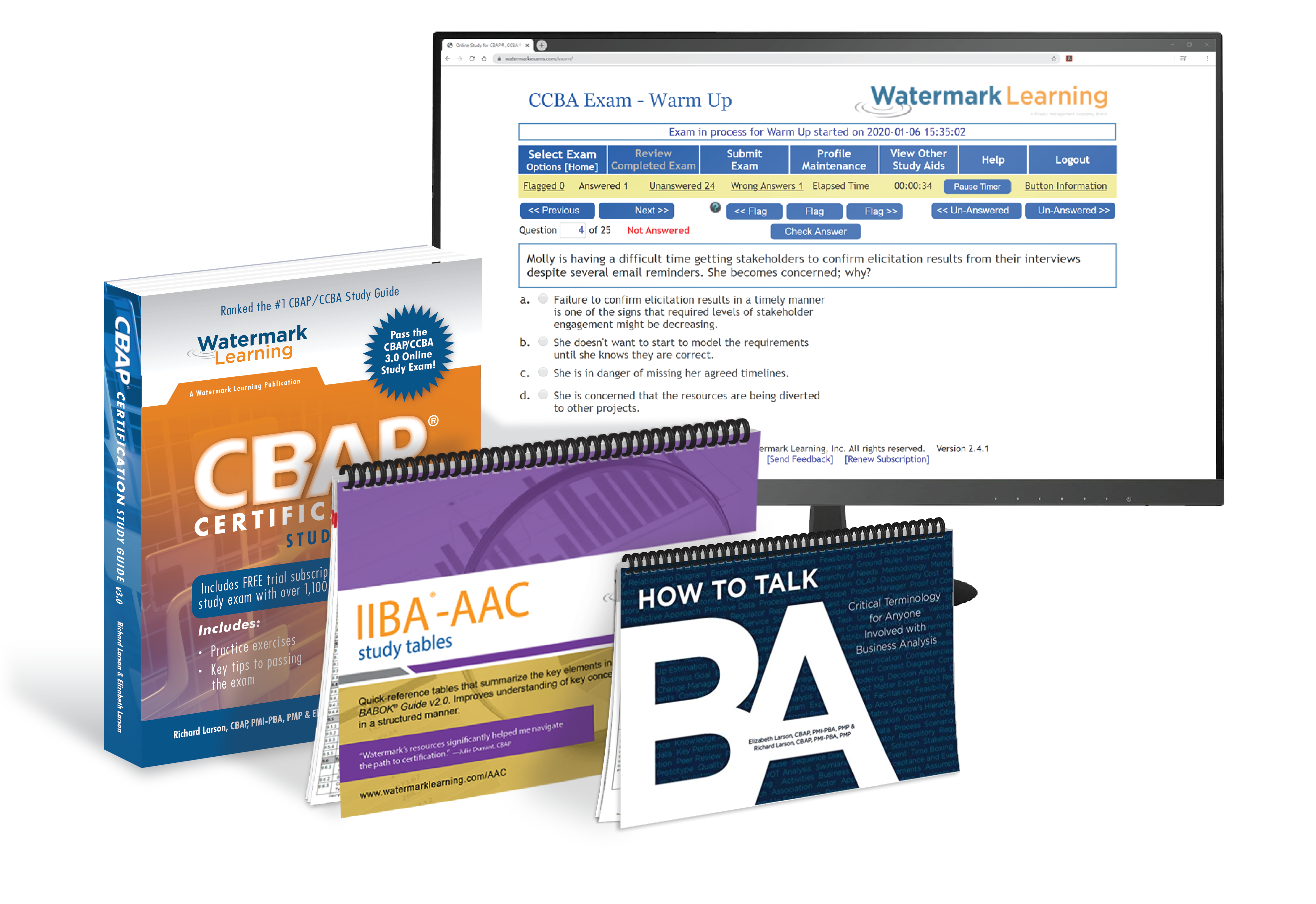
Online Exam Simulator
Increase your odds of passing, reduce exam anxiety, and save time with the most complete and realistic online practice exams in the market today.
The Watermark Learning Online Study Exam includes:
- Warm-ups, study drills, and the exam simulator
- Instant detailed feedback on every question
- Cloud-based for 24/7 Access
- And more
WATERMARK LEARNING CONTINUING EDUCATION
ALL THE PDUs/CDUs YOU NEED IN ONE PLACE
All courses approved through IIBA and PMI
View Requirements
Our Story
Since 1992, we have provided training and coaching in business analysis, project management, agile, BRM, BPM, and influencing and leadership skills that turn the complexity of industry standards into practical application. Our courses are laser-focused for the business analyst, project manager, and process analyst and lead to enduring results in organizations. Our classes are practical and engaging, and our instructors facilitate classes using interactive case studies which make students energized to learn…and motivated to perform.
About Us PMP Exam Preparation
 (877) 202-5959
 info@watermarklearning.com
 Mon - Fri | 8:00 AM - 6:00 PM EST


 New Horizons
 Project Management Academy
 Velopi
 Six Sigma Online
 Watermark Learning