

 New Horizons
 Project Management Academy
 Six Sigma Online
 TCM Security
 TRACOM
 Velopi
 Watermark Learning
 Login
Login


Key Takeaways
- Cohorts Surpass Workshops: Reinforcement turns learning into lasting leadership behavior
- Shared Practice Matters: Leaders improve faster when learning and practicing together
- Design Drives Results: Outcomes, cadence, and facilitation determine success
- Consistency Scales Leadership: Cohorts align expectations, feedback, and accountability
- Systems Over Events: Ongoing cohorts build repeatable leadership capability
Why One-Time Leadership Training Doesn’t Always Stick
Many leadership programs create a short-term lift. Leaders attend a workshop, leave with new ideas, and return to work motivated to apply what they learned.
Within weeks, those ideas are competing with full calendars, urgent priorities, and real team pressure.
Without reinforcement, even strong training often fades into good intentions.
This pattern became clear at XentinelWave. The organization had invested in solid processes and modern technology, yet leadership behaviors varied widely across teams. Some managers addressed issues early and clearly, while others delayed conversations or handled them inconsistently. The result was confusion, uneven performance, and repeated escalation.
Their experience reflects a broader organizational challenge. Leadership gaps rarely persist because leaders lack information. More often, leaders lack consistent opportunities to practice new behaviors, reflect on real situations, and recalibrate together.
Leadership cohorts address this gap by turning leadership development into ongoing shared practices, alignment, and experience. To understand why they work so well, it helps to start with what a leadership cohort is.
What Leadership Cohorts Really Are and Why the Difference Matters
Leadership cohorts are widely discussed, but the term is often misunderstood in practice. Without a clear definition, organizations may adopt the label without changing how leadership development works.
Clarity matters here. Structure determines whether leadership learning sticks or fades.
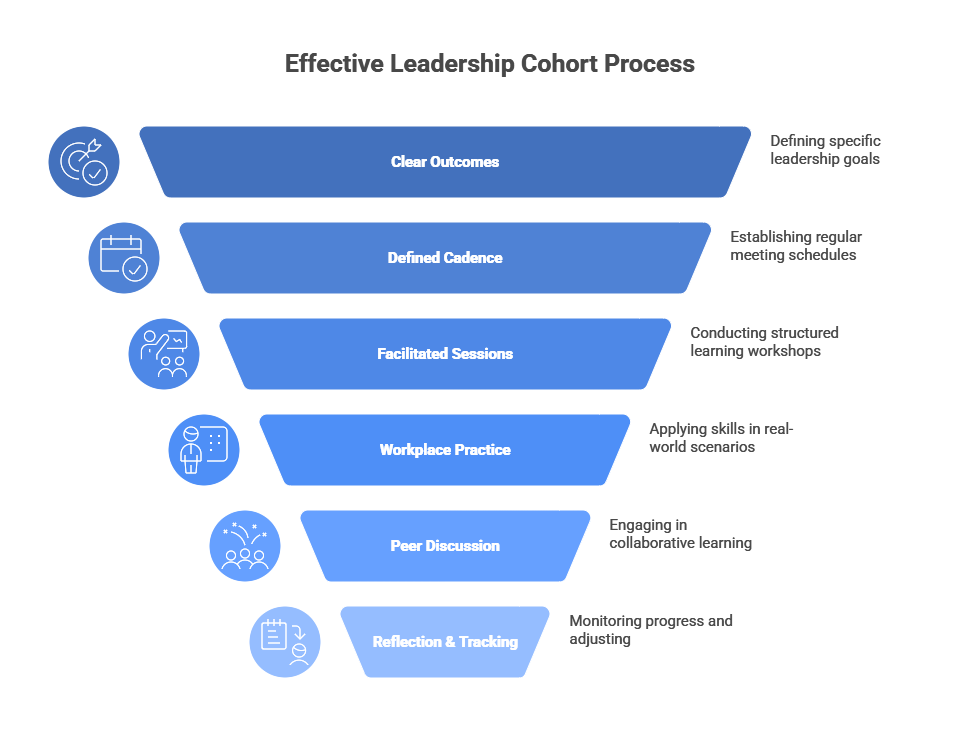
A leadership cohort is a structured group of leaders who move through a development experience together over a defined period. Participants learn the same skills, practice them in real work situations, and return to the group to reflect and adjust. The power of a Leadership Cohort comes from the collaboration and practice that can happen outside of the workshops that occur.
Most effective leadership cohorts include:
- a clear leadership outcome or set of outcomes
- a defined cadence such as biweekly, monthly, or quarterly
- facilitated learning sessions
- real workplace practice between sessions
- peer discussion and accountability
- reflection and progress tracking over time
Equally important is understanding what a leadership cohort isn’t. It isn’t a one-time workshop with a participant list. It isn’t a self-paced, independent course. It isn’t informal networking without practice or outcomes. And it isn’t a leadership program that ends when the final slide deck closes.
Organizations use cohorts across leadership levels, including new managers, emerging leaders, mid-level leaders managing other leaders, senior leaders, and cross-functional groups. Cohorts are often tied to business priorities such as growth, culture change, engagement, organizational alignment, or operational consistency.
This structure creates continuity, which allows cohorts to address one of the most persistent leadership challenges organizations face: inconsistent leadership behavior across teams. With that definition in place, the next step is to understand the organizational problem that cohorts are designed to solve.
The Leadership Gap Cohorts Are Designed to Close
Leadership cohorts exist because leadership inconsistency creates real operational and cultural risk. In many organizations, leadership quality varies dramatically from team to team, even when roles and expectations appear similar. Employees notice these differences quickly, and over time, those gaps affect performance, engagement, and trust.
That inconsistency shows up in practical ways, including:
- uneven performance expectations
- fragmented communication
- avoidable turnover
- recurring conflict and escalation
- frustration among high-performing employees
Awareness isn’t the issue. Most leaders already understand the importance of feedback, accountability, and clear expectations.
The difficulty is applying those behaviors consistently under pressure, when time is limited and tradeoffs feel immediate.
Leadership improves through repetition and reflection. Leaders need opportunities to try new approaches, see the impact, adjust, and try again. Doing this in isolation slows progress, creates confusion, and leads to a fragmented culture. Doing it alongside peers facing similar challenges accelerates it.
Cohorts create that environment. Over time, leaders build trust, learn from one another’s experiences, and develop shared standards for how leadership shows up in daily work. A cohort’s real strength is the bond that forms over time, as members face challenges together and learn from how they navigate them as a group. This shared momentum allows leadership development to shift from individual effort to organizational capability.
Why Leadership Cohorts Succeed Where Traditional Training Falls Short
Leadership cohorts aren’t the only way organizations develop leaders. They also aren’t the right solution for every situation. Most organizations already rely on a mix of workshops, courses, coaching, and retreats. Understanding how cohorts compare to these familiar approaches helps leaders choose the right tool for the outcomes they want to achieve.
Leadership cohorts are often compared to several common development models:
- One-time workshops: Workshops build awareness and shared language quickly. Without reinforcement, however, behavior change often fades once leaders return to daily pressures.
- Self-paced learning programs: Self-paced courses offer flexibility and work well for foundational knowledge. Their impact depends heavily on individual motivation and rarely creates shared leadership norms.
- Individual or executive coaching: Coaching provides deep, personalized development and can be transformative. It’s challenging to scale and often disconnected from peer learning and organizational consistency.
- Offsite leadership retreats: Retreats can build alignment and relationships quickly, and reinvigorate a new plan or mission. Their long-term value depends on what structures exist once leaders return to work.
The four suggestions above are great short-term, band-aid solutions. However, leadership cohorts are the glue that ensures that leaders are consistently getting the tools, skills, resources, and continuous learning they need to thrive in their workplace. They combine structure with flexibility, individual growth with peer learning, and short-term learning with long-term reinforcement. For organizations seeking consistent leadership behavior across teams, cohorts often provide the missing connective tissue.
Why Leadership Cohorts Drive Real Behavior Change
Leadership cohorts work because they align with how adults learn and change behavior at work. Their effectiveness isn’t accidental or theoretical.
It comes from reinforcing mechanisms that turn leadership development into something leaders actively practice rather than passively consume.
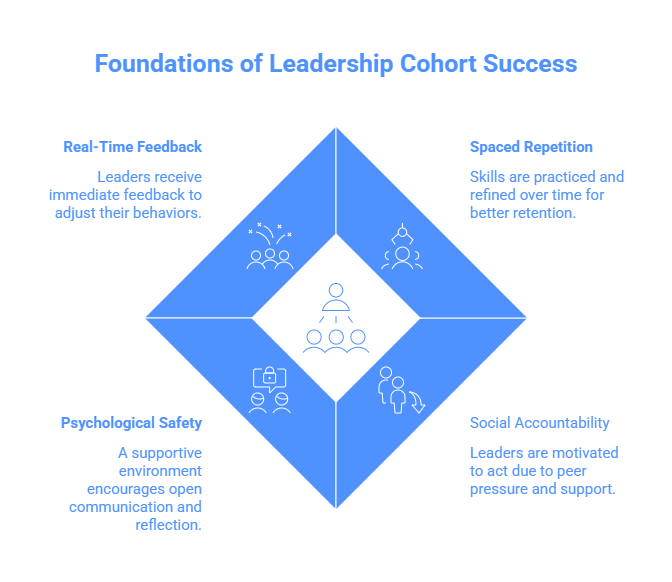
Leadership cohorts drive behavior change because they:
- Use spaced repetition instead of one-time exposure: Skills are introduced, practiced, revisited, and refined over time, improving retention and application under pressure.
- Create social accountability that increases follow-through: Leaders know they will return to the group and discuss what they tried, which increases the likelihood of action between sessions.
- Build psychological safety through continuity: Over time, leaders become more open about real challenges, leading to deeper reflection and better learning.
- Establish real-time feedback loops: Leaders test behaviors in live situations, reflect with peers, and adjust quickly.
Together, these mechanisms turn leadership development into an active cycle of application and refinement rather than a passive learning process. This explains why cohorts produce lasting behavior change and why their impact extends beyond individuals.
How Leadership Cohorts Improve Consistency Across Teams
When designed well, leadership cohorts create benefits that extend beyond individual participants. While personal growth matters, organizations ultimately care about how leadership shows up across teams and systems.
Cohorts improve training-to-behavior transfer by tying learning directly to daily work. Leaders don’t just understand concepts. They practice leadership behaviors repeatedly.
Cohorts also improve leadership consistency by aligning leaders around shared standards, including:
- setting expectations
- delivering feedback
- addressing conflict
- holding accountability conversations
Another benefit is reduced leadership isolation. Many leaders struggle quietly with difficult conversations, disengagement, or cross-team friction.
Cohorts give leaders a place to work through these challenges before they escalate into larger issues. Not only does this strengthen the leader’s skillset, it also enhances the shared experience of all leaders going through this together.
Over time, these repeated behaviors shape culture. Culture is built through what leaders reinforce daily, especially under pressure. Cohorts help ensure those behaviors are more consistent across the organization.
Finally, cohorts strengthen leadership readiness and succession by building a deeper bench of leaders prepared for greater responsibility and mobility. That long-term impact raises an important consideration: how organizations design cohorts for sustained growth rather than short-term gains.
How to Design Leadership Cohorts That Last
Leadership development doesn’t end after a few weeks, even when early results are positive. Organizations that see lasting impact treat cohorts as part of a broader leadership system rather than a one-time initiative.
While some cohorts run for six to twelve weeks, others evolve into multi-year communities. These longer approaches support continuous development without overwhelming participants.
Successful long-term cohort models include:
- multi-month cohorts with quarterly reinforcement sessions
- multi-phase cohorts that develop leaders across an increasing scope
- annual cohorts supported by alumni mentoring and peer coaching
What makes these models sustainable is balance. Effective cohorts use manageable cadences, rotate themes, focus on practical assignments in between sessions, integrate coaching and mentoring, and rely on consistent facilitation rather than heavy workloads. With these principles in place, attention naturally shifts from sustainability to execution.
How to Build a Leadership Cohort That Changes Behavior
Design determines whether a leadership cohort creates lasting change or fades after initial enthusiasm. Even well-intended programs lose momentum without clear outcomes, structure, and accountability.
Effective cohorts start with clarity about what leaders should do differently, not just what they should learn.
This distinction shapes every design decision that follows.
Strong cohort design begins with specific leadership outcomes. These outcomes describe observable behaviors, such as clearer feedback or earlier accountability conversations.
Next, organizations choose the right audience. New managers often need structure quickly, while emerging leaders may need preparation for broader influence. Matching the cohort to readiness increases learning impact.
Cohorts also require a realistic cadence. Weekly, biweekly, or monthly formats all work when leaders can sustain them.
Each session should follow a learn, practice, apply rhythm:
- one focused leadership skill
- a practical tool or framework
- structured practice
- a small workplace application
- reflection in the next session
Peer accountability and behavior-based measurement keep cohorts focused on real application rather than intention alone. Without these elements, even strong designs can lose momentum, underscoring the importance of understanding where leadership cohorts often go off track.
Why Leadership Cohorts Lose Momentum and How to Prevent It
Leadership cohorts are difficult to launch and easy to undermine through small design and execution missteps if expectations aren’t clear.
When expectations are unclear or reinforcement is skipped, momentum fades quickly.
Common pitfalls include:
- treating participation as optional
- overloading sessions with content
- relying on discussion without practice
- weak facilitation that erodes trust and honest engagement
Acknowledging these risks helps organizations move beyond short-term activity and design cohorts that deliver lasting value. When these pitfalls are addressed intentionally, leadership cohorts become more than a program. They become part of a scalable leadership system.
Leadership Cohorts as a Scalable Leadership System
Long-term cohort design focuses on sustaining development. Scalability focuses on making leadership capability repeatable across the organization as it grows and changes. When leadership cohorts are designed and sustained effectively, they support both.
Cohorts become more than a development program. They create a repeatable system for building leadership capability at multiple levels. This shift from isolated training to shared practice allows leadership development to scale with the organization.
The result isn’t just stronger individual leaders. It’s more consistent and aligned leadership across the organization, which supports engagement, performance, and long-term stability.
Ready to move leadership development beyond one-time training?
Watermark Learning helps organizations design leadership cohorts that build consistency, reinforce real-world practice, and scale leadership capability over time. Let’s explore what a cohort approach could look like in your organization.

Jay Pugh, PhD
Dr. Jay Pugh is an award-winning leader, author, and facilitator with over 18 years of teaching and training experience. Currently serving as Head of Leadership Growth at Educate 360, he leads a robust team of external and internal facilitators who specialize in developing leadership capabilities within medium and large-scale businesses. His team works directly with business professionals, helping them become more effective leaders in their daily operations.
Dr. Pugh holds a Ph.D. in Instructional Management and Leadership, and his academic contributions include two published articles and a dissertation focusing on various educational topics. His extensive experience and academic background have established him as a respected voice in leadership development and educational management.


 New Horizons
 Project Management Academy
 Velopi
 Six Sigma Online
 Watermark Learning