

 New Horizons
 Project Management Academy
 Six Sigma Online
 TCM Security
 TRACOM
 Velopi
 Watermark Learning
 Login
Login


Key Takeaways
- Direction Has Limits: Clear goals cannot sustain performance on their own
- Capability Is Always Moving: Strength grows, holds steady, or weakens
- Escalation Signals Risk: Rising approvals reveal shrinking ownership
- Habits Shape Strength: Leadership behavior influences decision confidence
- Stewardship Sustains Performance: Clear authority reduces reliance on executives.
When Direction Stops Being Enough
Executive teams spend a great deal of time setting direction. Strategic priorities are defined, targets are assigned, and departments align their plans around shared goals. For a period, that structure creates stability. Work moves, reports look solid, and the organization feels coordinated.
At XentinelWave, the executive team began noticing shifts across finance, operations, and product. Department leaders brought forward decisions they once handled on their own. Cross-functional issues returned to the same executive discussions, even after they had already been addressed.
On paper, nothing seemed broken. Performance metrics stayed within range, and major deadlines were met. Yet senior leaders found themselves pulled into more routine approvals, and meetings stretched longer as teams hesitated before committing.
No one could point to a dramatic failure. The strategy was clear, and expectations had been communicated, yet more work began stalling until someone at the top weighed in. Something beneath the surface had shifted, even if the reports did not show it yet.
Capability Is Always Moving
Organizational capability doesn’t hold its shape for long. Across departments, it either strengthens through use, levels off through habit, or weakens when decisions begin moving upward. Leaders influence that direction every day, whether they intend to or not.
The movement isn’t abstract. It shows up in meeting agendas, approval patterns, and how quickly teams move when something unexpected happens. Some departments begin acting with more confidence. Others begin waiting for guidance that wasn’t required before.
Leaders can usually spot movement before they can name the pattern. A few signals tend to surface first.
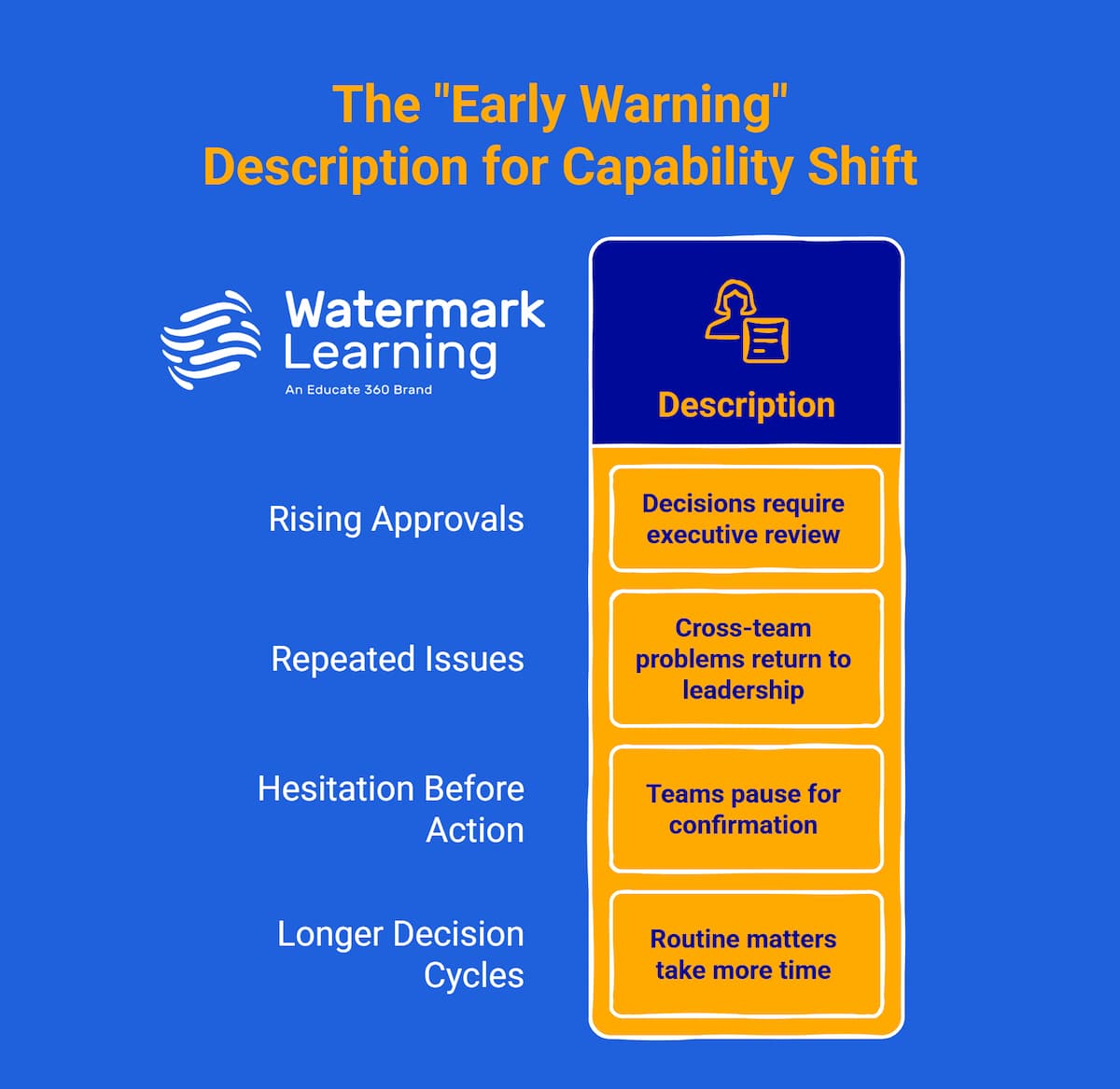
Early Signs Capability Is Shifting:
- Rising Approvals: Decisions that once stayed within departments now require executive review.
- Repeated Issues: The same cross-team problems return to leadership meetings.
- Hesitation Before Action: Teams pause for confirmation instead of acting within clear boundaries.
- Longer Decision Cycles: Routine matters take more time to resolve than they did before.
These patterns don’t appear all at once. They build across departments as routines take hold until the direction becomes clear in how decisions flow through the organization.
At XentinelWave, executives began noticing that more items required formal sign-off than in prior quarters. What used to be updates became approval requests. The strategy had not changed, yet the organization’s capacity to act within it had.
Slipping capability shows up in small ways: more check-ins, more approval requests, and more items pushed up the chain. Leaders need to name whether decision-making is strengthening, holding steady, or narrowing. Only then can they see which path the organization has settled into.
Which Capability Path Is Your Organization On
Once leaders start paying attention to how decisions move, patterns become easier to see. Most organizations settle into one of three paths as patterns repeat, even if no one names it out loud. Each path shows up in daily work, in how authority is handled, and in how much executive attention routine issues require.
These paths aren’t abstract categories. They show up in who speaks first in meetings, who hesitates before committing to action, and how often senior leaders are asked to weigh in. The difference between them isn’t intent. It’s the level of confidence across the organization.
Leaders can usually identify the path by looking at how decisions and accountability move across departments.
Three Organizational Capability Paths
- Strengthening: Department leaders act within clear boundaries, cross-team issues get resolved at the right level, and executive meetings focus on direction rather than routine approvals.
- Holding Steady: Work gets completed on time, routines stay familiar, and most challenges are handled the same way they’ve been handled before.
- Weakening: Approval requests increase, issues flow up the chain sooner, and executives spend more time clarifying decisions that others once made for themselves.
Each path carries different implications for the leadership team. A strengthening path frees senior leaders to focus on longer-term questions. A steady path maintains performance but rarely expands it. A weakening path narrows ownership and increases reliance on executive oversight.
Understanding which path an organization is on changes the conversation. Instead of debating isolated problems, leaders can ask what those problems signal about capability itself. From there, the focus turns to leadership responsibility and how it shapes the direction capability takes.
Leadership Looks Different When Capability Is the Goal
Leadership responsibility starts to look different once capability becomes the focus. Setting direction still matters, but it no longer explains why decisions stall or ownership narrows. The real question becomes: how do leaders shape the conditions that allow others to act with confidence?
Leadership attention often stays centered on priorities and performance targets. When problems surface, senior leaders step in to keep work moving, and as the pattern repeats, ownership narrows across departments. Decisions begin clustering closer to the top.
A shift in focus changes what happens next. The difference becomes visible in how leaders approach ownership and system design.
What Shifts When Leaders Become Capability Stewards
- Decision Ownership: Clarify who decides what and resist pulling decisions upward.
- Problem Solving: Develop judgment instead of resolving every issue.
- System Design: Fix unclear processes rather than correcting individuals.
These shifts don’t require a new structure. They show up in how meetings are run and how questions are asked. As consistency builds, teams begin acting with greater clarity because authority boundaries feel steady.
When leadership shifts from directing work to shaping capability, the conversation changes. Instead of asking whether a task was completed, leaders ask whether the organization is stronger than it was last quarter. The focus moves to behaviors that build or weaken capability.
What Leaders Do That Builds Capability
Once leaders accept that capability can move in either direction, the question becomes practical. What do leaders do that strengthens it rather than narrows it? The answer shows up in daily habits more than in strategy statements.
Leadership effort often centers on reviewing results. Teams report progress, leaders respond to issues, and priorities get reinforced. Strengthening capability requires a different lens, one that shifts attention from outcomes alone to how those outcomes are achieved.
The difference shows up in consistent behaviors that shape how departments think and act.
Daily Leadership Behaviors That Build Capability
- Clarify Authority: Define who decides what, so teams don’t pause for unnecessary approval.
- Reinforce Boundaries: Hold steady on decision levels instead of stepping in too quickly.
- Review Patterns: Look for recurring issues that signal unclear ownership.
- Share Lessons: Make learning visible across departments after major initiatives.
No new programs or formal rollouts are required. They appear in meeting structure, in how questions are framed, and in how leaders respond when something goes wrong. As expectations remain consistent, teams become more certain.
Capability strengthens when leadership behavior stays steady across departments. If senior leaders pull decisions upward one week and push them down the next, confusion follows. Consistency builds confidence and helps leaders see whether capability is moving in the right direction.
The Signals Leaders Shouldn’t Ignore
Leaders don’t have to guess whether capability is strengthening or slipping. The signs appear in daily work long before performance numbers change. Paying attention to those signals helps leaders respond before small shifts turn into larger problems.
Early signals show up in meeting patterns and decision flow, where approval requests cluster at higher levels and the same issues resurface across departments. Delays begin stretching timelines that once felt predictable.
Leaders can look for a few consistent indicators across teams.
Signals Leaders Should Watch
- Decision Flow: Are decisions handled at the right level, or do they rise upward by default?
- Escalation Volume: Are routine matters reaching executives more often than before?
- Issue Recurrence: Do the same operational problems appear across multiple meetings?
- Meeting Focus: Do executive agendas center on direction or on reviewing routine approvals?
When these signals shift, capability shifts with them. A single approval request does not signal decline, but a steady increase does. Leaders who watch patterns instead of isolated events gain a clearer picture of organizational strength.
Clear signals keep leaders honest about what they’re seeing. Patterns in decision flow often reveal more than performance reports. When leaders treat those patterns as feedback, they begin examining the habits shaping capability.
When Good Intentions Create Dependence
Capability doesn’t weaken on its own. It narrows through leadership habits that feel productive in the moment. As those habits repeat, ownership shifts upward and confidence across departments declines. What begins as support turns into dependence.
In many organizations, these habits develop with good intentions. Senior leaders step in to keep work moving or to prevent mistakes. Teams appreciate the support, and short-term results stay on track. As the pattern continues, responsibility for decisions begins to shift.
The shift becomes visible in a handful of recurring behaviors.
Common Leadership Habits That Narrow Capability
- Frequent Intervention: Leaders step in before teams work through decisions on their own.
- Centralized Approval: Routine matters require executive sign-off rather than remaining at the appropriate level.
- Outcome Over Ownership: Results are reviewed without examining the decision-making process.
- Skipped Reflection: Teams move on quickly without discussing what could improve next time.
These habits rarely feel harmful when they happen. Each one is a practical response to a real situation. Taken together, though, they send a message about where authority lives and who is expected to decide.
Leaders who recognize these patterns can interrupt them before they become routine. Shifting attention from control to capability requires awareness first. The focus then turns to how leaders at every level build strength in the teams they oversee.
What It Takes to Become a Capability Steward
Shifting leadership focus is not a one-time adjustment. It requires steady practice across levels of the organization. Leaders at different stages of experience influence capability in different ways, and each role carries distinct responsibilities.
Developing as a capability steward looks different depending on where a leader sits. Emerging leaders shape decision confidence within their teams. Experienced leaders influence how systems connect across departments. Senior leaders determine whether authority stays clear or drifts upward.
Growth in this area starts with recognizing where influence is strongest.
How Capability Stewardship Shows Up at Different Levels
- Emerging Leaders: Build clarity within their teams and encourage decisions at the right level.
- Experienced Leaders: Strengthen coordination across groups and reinforce consistent boundaries.
- Senior Leaders: Design structures that support ownership without constant executive involvement.
Each level contributes to the same outcome, but the focus shifts with scope. Emerging leaders shape habits inside their teams. Senior leaders shape the environment in which those teams operate.
When leadership development addresses these differences, capability strengthens across the organization instead of in pockets. Stewardship becomes part of how leaders see their role, not an added responsibility. The focus returns to sustained performance as complexity increases.
Building Capability That Lasts
Leadership sets direction, but direction alone won’t sustain performance. Organizational capability determines whether teams act with confidence or wait for permission. When ownership stays clear, decisions move faster and problems stay where they belong. When it narrows, even strong strategies strain.
At XentinelWave, the shift became visible within a year. Approval requests to the executive team declined by 28 percent. Cross-department decisions moved faster, and recurring issues appeared less often in senior meetings. Leaders regained time for long-term priorities.
Sustaining capability requires more than awareness. Leaders must clarify authority, reinforce boundaries, and design systems that support confident decisions.
Watermark Learning works with executive and cross-department leadership teams ready to strengthen capability across their organization. Through practical leadership development grounded in real operational dynamics, leaders clarify authority, reinforce ownership, and build teams that perform without constant oversight.
If approvals are rising and decisions keep drifting upward, it’s time to strengthen capability. Watermark Learning helps leadership teams build strength that lasts.
Related Leadership Training:
- Leadership Excellence for Senior Management
- Becoming a Transformational Leader
- Evolving into the Manager Role

Jay Pugh, PhD
Dr. Jay Pugh is an award-winning leader, author, and facilitator with over 18 years of teaching and training experience. Currently serving as Head of Leadership Growth at Educate 360, he leads a robust team of external and internal facilitators who specialize in developing leadership capabilities within medium and large-scale businesses. His team works directly with business professionals, helping them become more effective leaders in their daily operations.
Dr. Pugh holds a Ph.D. in Instructional Management and Leadership, and his academic contributions include two published articles and a dissertation focusing on various educational topics. His extensive experience and academic background have established him as a respected voice in leadership development and educational management.


 New Horizons
 Project Management Academy
 Velopi
 Six Sigma Online
 Watermark Learning