

 New Horizons
 Project Management Academy
 Six Sigma Online
 TCM Security
 TRACOM
 Velopi
 Watermark Learning
 Login
Login


Key Takeaways
- Know requirement types to avoid mixing business goals with system features.
- Elicit context early by asking targeted questions that uncover gaps and risks.
- Match formats to audiences so executives, users, and developers gain clarity.
- Write testable statements that define measurable outcomes and reduce ambiguity.
- Prioritize and maintain scope to guide decisions and prevent uncontrolled change.
Why Clear Requirements Matter More Than Teams Realize
Clear requirements guide planning, collaboration, and delivery toward outcomes that match organizational goals. When analysts take time to understand the problem, document with precision, and maintain alignment, teams work with far greater confidence. These habits reduce rework and help stakeholders stay focused on what matters most.
At XentinelWave, these challenges surfaced as projects expanded faster than leadership alignment. Analysts documented functional details well but struggled to express the business outcomes behind them. Without stronger guidance, their reliable tools and processes were not enough to create shared clarity.
As work accelerated, assumptions replaced conversations and misunderstandings multiplied. Teams delivered features that didn’t reflect actual needs, and stakeholders questioned why results felt misaligned. Organizational leaders realized they were documenting solutions before confirming the underlying problems.
This article explores how to confront those gaps and outlines practical steps for writing clear, high-quality business requirements that support consistent delivery.
What Business Requirements Really Mean and Why They Matter
Strong projects begin with clarity, and understanding business requirements starts with recognizing the project’s purpose. Analysts often shift into technical details too quickly, especially without clear leadership direction. Clear business requirements define the need before exploring solutions and help teams stay aligned from the beginning.
During a leadership-requested review meeting, XentinelWave’s BA manager explained how projects drifted without clear outcomes. “We kept jumping into features because we didn’t have clarity,” she said. Her comment underscored the need to return to the basics and refocus on each initiative’s true purpose.
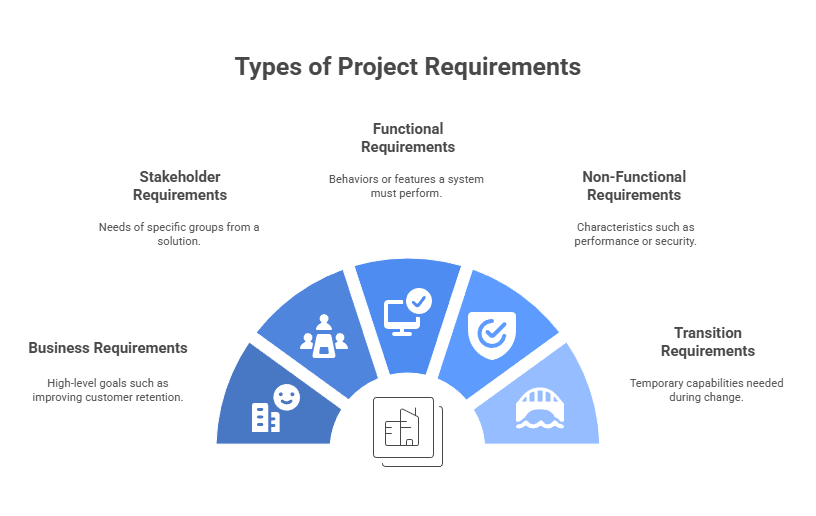
To help analysts distinguish requirement levels, the following list summarizes the types most projects rely on.
Types of Common Requirements
- Business requirements: high-level goals such as improving customer retention.
- Stakeholder requirements: what specific groups need from a solution.
- Functional requirements: behaviors or features a system must perform.
- Non-functional requirements: characteristics such as performance or security.
- Transition requirements: temporary capabilities needed during change.
Analysts are responsible for more than just gathering requirements. They also define scope: what the solution must include, what it should leave out, and how it fits into the broader environment. Clear scope helps prevent confusion and keeps the project focused.
Elements That Define Scope
- In-Scope Items: What the solution must cover or deliver.
- Out-of-Scope Items: What’s excluded to avoid misaligned expectations.
- Problem Statement: A concise summary of the core business need.
- Context Diagram: A visual map of systems, users, and interactions.
Knowing requirement types and scope boundaries helps analysts define business needs more clearly. These foundations make it easier to ask the right questions. They lead to deeper insight, clearer documentation, and better outcomes.
Don’t Write Yet. Ask Better Questions First
Successful analysis shows that strong requirements start with strong discovery. Analysts need reliable input before documenting anything, yet this step is often rushed when leadership expectations are unclear. Good elicitation builds shared understanding and provides analysts with the context to write accurate requirements.
As the meeting continued, the operations director noted how early uncertainties shaped their work. “We didn’t ask enough questions upfront, so people filled gaps on their own,” he said. Analysts recalled similar moments when missing context slowed progress, reinforcing how much more confident they would feel when the whole picture is clear from the start.
To support that discovery, analysts can rely on structured methods such as the following.
Common Elicitation Activities
- Interviews to uncover needs
- Workshops to align teams
- Observations to see workflows
- Reviews to gather context
Questions That Strengthen Understanding
- What’s the problem?
- Who’s affected?
- What defines success?
- What are the risks?
Common Elicitation Pitfalls
- Jumping to solutions
- Missing stakeholder voices
- Documenting early assumptions
These reminders help analysts stay grounded as they gather information that will shape the work ahead.
Thorough elicitation builds confidence in the information shaping a project and reduces later misunderstandings. When context is gathered with care, requirements reflect real needs instead of assumptions. These habits give teams a clearer foundation for sharing requirements in ways others can easily understand.
The Format Problem and Why Teams Misread Requirements
Choosing the right requirement format is essential for helping teams interpret information the same way. Because audiences absorb information differently, mismatched formats often create confusion. When leadership direction is limited, analysts may rely on habit rather than intention, leading to inconsistent documentation.
Later in the meeting, the product lead admitted that formats often felt mismatched. “We defaulted to user stories even when a simple summary would have helped,” he said. Others agreed that inconsistent choices made information harder to use. The group recognized how much smoother collaboration could be when formats matched audience needs and agreed to be more intentional in choosing them.
Common Requirement Formats
- User stories: support Agile teams with outcome-focused statements.
- Use cases: describe step-by-step interactions.
- Requirement lists: provide structured documentation.
- Process diagrams:show workflows and data movement clearly.
Selecting formats intentionally helps stakeholders absorb information in ways that support accurate interpretation. When documentation aligns with how audiences process detail, conversations flow more smoothly, and decisions become clearer. Purposeful choices at this stage make requirements easier for everyone to work with.
How to Turn Vague Requirements into Testable Statements
High-quality requirements express ideas clearly and make outcomes easy to verify. Ambiguity grows when leadership expectations are unclear, and analysts may hesitate to seek clarification. Clear, measurable statements help teams stay aligned and reduce rework.
The QA director shared her perspective as the team reviewed vague statements. “We couldn’t test certain requirements because they didn’t define success,” she said. Analysts noted how much more productive their work would be if expectations were unmistakable from the outset.
Analysts often benefit from a quick reference list when checking for quality.
Characteristics of Strong Requirements
- Clear meaning: allow stakeholders to interpret them consistently.
- Concise wording: avoid unnecessary detail.
- Feasible scope: fit within constraints.
- Testable criteria: support measurable validation.
- Traceable links: connect back to business goals.
- Single focus: express one requirement at a time.
Examples of Weak vs. Strong Requirements
- “The system should be user-friendly” versus “New users should complete checkout within three minutes without assistance.”
- “Reports should run quickly” versus “Reports should generate within ten seconds during peak hours.”
Clear, testable requirements give teams a dependable picture of what success looks like. When expectations are specific and measurable, progress becomes easier to evaluate and less vulnerable to confusion. This clarity supports steady momentum and helps teams make informed decisions as work progresses.
Why Everything Can’t Be a Top Priority
Prioritizing requirements helps teams focus effort where it delivers the most value. Without clear leadership direction, everything can seem equally important and difficult to sequence. Structured prioritization clarifies decisions, supports constructive stakeholder discussions, and guides teams toward the outcomes that matter most.
When the topic surfaced, the portfolio director spoke plainly. “We labeled too many items as top priority because we weren’t aligned,” he said. The discussion prompted the group to consider how shared purpose could guide clearer priority decisions going forward.
Prioritization Techniques
- MoSCoW method: classify must-have vs. optional needs.
- Value-versus-effort ranking: clarify trade-offs.
- Stakeholder voting: reveal contrasting perspectives.
- Risk-based prioritization: identify items with high impact if delayed.
Illustrative Prioritization Example
If two requirements offer equal value but one carries a higher risk if delayed, prioritizing the risk-heavy item often prevents downstream disruption. Small comparisons like this make prioritization discussions more concrete.
Well-reasoned prioritization helps teams focus on the work that brings the most value and aligns with business needs. When priorities are transparent, stakeholders can engage more constructively and plan with greater confidence. This shared understanding creates stability as work moves forward and helps teams recognize where confirmation is still needed.
Avoid Late Surprises with Early Validation
Validation ensures requirements reflect real needs and align with organizational goals. When analysts skip confirmation, misunderstandings appear later and slow progress. Strong leadership reinforces the value of review. With consistent validation, teams move forward with more confidence and fewer surprises.
Near the end of the meeting, the CTO reflected on skipped reviews. “We moved ahead without checking our assumptions, and it slowed us later,” he said. Analysts remembered similar moments and agreed that confirming understanding earlier would help keep future work on steadier ground.
Validation Steps
- Share early drafts: surface gaps before they cause delays.
- Host walkthroughs: confirm shared understanding.
- Check feasibility: ensure alignment with technical limits.
- Record revisions: keep updates visible and traceable.
Effective validation ensures that documented requirements reflect a genuine shared understanding. When feedback is incorporated early, teams experience fewer disruptions and clearer expectations as they continue their work. These practices contribute to steadier progress across the project lifecycle.
How to Keep Requirements Clear as Projects Evolve
In any project, managing requirements over time is just as important as writing them well. As projects progress, details shift, expectations evolve, and leadership gaps can make those changes hard to track. Consistent maintenance protects earlier decisions and helps teams stay coordinated throughout delivery.
As the meeting wrapped up, the project manager shared one last concern. “We treated drafts as finished work, so updates were scattered,” she said. Others recalled how difficult it became to trace decisions when changes lacked structure. The group left with a clearer sense of the stability that organized maintenance brings.
Requirements Maintenance Practices
- Version control: record changes over time.
- Revision history: show how requirements evolved.
- Consistent IDs: support clear referencing.
- Linked artifacts: maintain traceability to tasks and tests.
Change Management Steps
- Assess impact: review effects on scope, timeline, and resources.
- Communicate updates: inform affected stakeholders.
- Update documents: keep information accurate and current.
- Maintain audit trails: support compliance needs.
Analysts often rely on simple tracking tools, such as requirement logs and change trackers, to keep updates visible and consistent as work progresses.
Consistent requirements management keeps information accurate and dependable as conditions change. When updates are handled with structure and visibility, teams stay aligned and avoid unnecessary confusion. Reliable maintenance practices reinforce stability and support stronger outcomes overall.
The Long-Term Impact of Clear Requirements
Clear requirements guide planning, collaboration, and delivery toward outcomes that match organizational goals. When analysts understand the problem, write with precision, and maintain alignment, teams move with greater confidence. These habits reduce rework and keep everyone focused on what matters most, laying the groundwork for meaningful long-term improvement.
Twelve months later, XentinelWave saw notable improvements. Requirement defects decreased, and teams collaborated with more confidence. Clearer leadership direction helped analysts apply solid processes more intentionally, leading to stronger alignment across projects.
Strong requirements practices continue to grow over time, supported by steady habits and a shared language across teams.
Watermark Learning supports your teams’ growth and strengthens their business analysis expertise. Explore our courses to see how they strengthen elicitation, documentation, analysis, and stakeholder engagement, making your BAs trusted partners in guiding solutions.

Jay Pugh, PhD
Dr. Jay Pugh is an award-winning leader, author, and facilitator with over 18 years of teaching and training experience. Currently serving as Head of Leadership Growth at Educate 360, he leads a robust team of external and internal facilitators who specialize in developing leadership capabilities within medium and large-scale businesses. His team works directly with business professionals, helping them become more effective leaders in their daily operations.
Dr. Pugh holds a Ph.D. in Instructional Management and Leadership, and his academic contributions include two published articles and a dissertation focusing on various educational topics. His extensive experience and academic background have established him as a respected voice in leadership development and educational management.


 New Horizons
 Project Management Academy
 Velopi
 Six Sigma Online
 Watermark Learning