

 New Horizons
 Project Management Academy
 Six Sigma Online
 TCM Security
 TRACOM
 Velopi
 Watermark Learning
 Login
Login


Key Takeaways
- Humor Builds Safety: Shared light moments help teams feel grounded and connected.
- Leaders Shape Tone: Consistent behaviors from leaders influence how groups communicate.
- Choose Safe Styles: Inclusive humor helps teams participate more freely.
- Timing Influences Impact: Humor works best when trust exists and the moment supports connection.
- Recovery Matters: Quick accountability restores trust when humor does not land as planned.
Humor Works as a Leadership Skill, Not a Trait
Humor may feel like a personality trait, but in leadership, it works as a simple social tool. A small moment of levity can help teams relax, talk more easily, and rebuild trust. It can shift the tone of a room without changing the work.
At XentinelWave, leaders noticed their teams growing quiet during a demanding project cycle. Meetings moved quickly, but they did not give people space to speak openly. Participation faded even as processes stayed consistent. Meetings felt tense, shaping people’s engagement.
This tension highlighted a cultural gap. The tools and systems were working, but the human side of collaboration needed more attention. Leaders saw that teams wanted more room for natural conversation and shared energy. They began exploring small cues that could help people reconnect.
This article explores how humor supports group culture, how to use it responsibly, and what XentinelWave leaders discovered in their discussions. These insights offer practical ways for leadership teams to strengthen the environment for collaboration.
How Humor Helps Leaders Create Real Connection
Humor can feel uncertain in professional settings, yet it helps build psychological safety and group trust. When a team feels pressure, a light moment can help people settle and engage again. It creates room for more relaxed conversation and stronger collaboration. Shared moments of humor also reveal how teams relate under pressure and how ready they are to speak openly.
Humor supports stronger leadership by helping teams:
- Reduce Stress: Teams regain steadiness and emotional balance
- Encourage Openness: People feel safer sharing concerns and ideas
- Build Trust: Authentic moments strengthen relationships
- Lower Tension: Conversations feel more grounded
- Boost Engagement: Groups participate with greater energy
During a leadership meeting at XentinelWave, the operations director reviewed recent engagement scores and paused. “Our systems are strong, but our teams look worn down and disengaged,” she said. Her comment shifted the room. Leaders began reflecting on how the past few months had shaped team interactions and left people hesitant to speak freely.
Humor becomes most useful when it helps groups feel grounded and connected. It creates a calmer atmosphere and supports the trust teams need to collaborate fully. As leaders work with this idea, many notice the kinds of humor that help people participate openly. hat awareness makes it easier to choose humor that strengthens trust instead of creating tension.
How Humor Builds Trust Without Going Too Far
Humor supports culture only when people feel comfortable participating. Leadership groups benefit from noticing which styles bring teams together and which ones create tension. The goal is not to be funny for the sake of being funny, but to support a stronger sense of belonging.
Helpful humor styles include:
- Light observational comments
- Gentle self-awareness shared sparingly
- References that include the broader group
- Situational remarks that acknowledge shared experiences
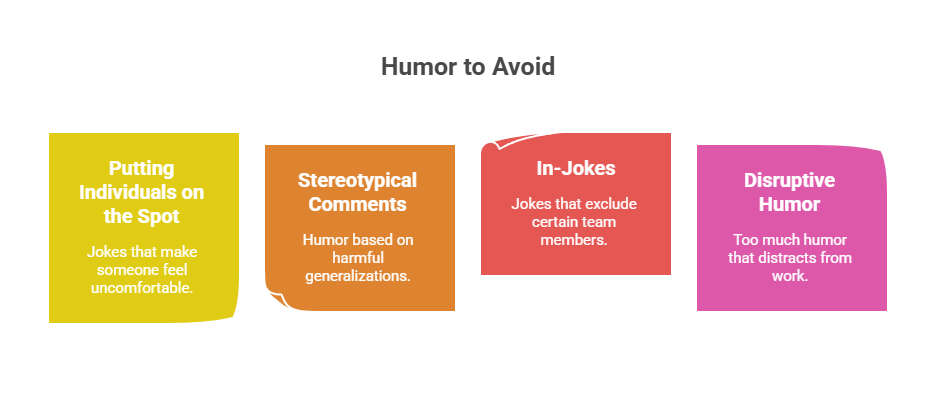
Humor to avoid includes:
- Jokes that put individuals on the spot
- Comments built on stereotypes or personal traits
- In-jokes that leave out newer or quieter team members
- Frequent humor that disrupts group focus
As the discussion shifted to communication habits, the HR director shared a recent moment. “I sometimes joke about my scheduling mistakes,” she said. “It seems to make the team more willing to admit their own challenges.” The group noted how small, self-aware comments can lower pressure and help the room feel more even.
Choosing humor that fosters belonging strengthens a team’s social fabric. When leaders focus on humor that helps people feel included, conversations feel easier and more open. As groups become more comfortable, leaders gain a clearer sense of when humor supports the moment and when thoughtful restraint creates a better path forward.
Knowing When Humor Helps and When It Doesn’t
Humor has the greatest impact when it supports the emotional tone already in the room. Leadership teams often notice how a well-timed comment helps people settle and engage more confidently. These moments do not need to be big. Even a simple shared laugh can help people feel more connected.
As leadership groups explore this more intentionally, they often start by noticing simple, low-stakes moments where levity can ease tension without pulling focus from work.
Good moments for humor:
- Opening or closing meetings
- Introducing a brief pause when tension rises
- Acknowledging shared frustrations with care
- Celebrating progress or everyday team wins
Times when humor needs caution:
- Delivering serious or corrective feedback
- Early stages of team formation
- High-pressure periods with unclear expectations
- Conversations where psychological safety is still forming
Later in the meeting, the product vice president recalled a tense project review. “I mentioned my emergency chocolate stash before we talked about the delay,” he said. “People relaxed almost immediately.” The leaders noted how a quick, light remark can settle a group enough for them to approach work with a clearer perspective.
Using humor at the right moment can shift a room from tense to more relaxed, helping discussions flow more easily. Leaders who pay attention to timing learn how people respond to different tones and how varied team preferences can be. These insights help leaders use humor with more clarity and prepare them for the cultural and contextual factors that shape how humor is received.
Why Culture and Context Matter in Humor
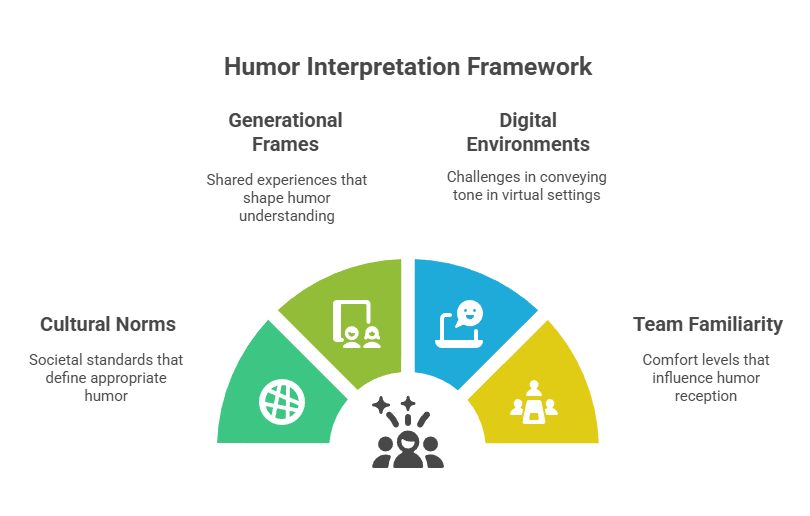
Humor varies across cultures, generations, and communication styles. What feels natural to one group may feel awkward to another. These differences become more noticeable in virtual settings where tone is harder to read. In remote and hybrid work, leaders and teams rely on clearer cues because the usual in-person signals are not available.
Factors that shape how humor is interpreted include:
- Cultural Norms: Groups differ in what feels appropriate
- Generational Frames: References resonate differently
- Digital Environments: Tone is easier to misread
- Team Familiarity: Comfort affects interpretation
When the conversation turned to global teams, the programs lead shared a recent experience. “I tried a sarcastic comment, and it fell flat with the group in Singapore,” she said. She explained how switching to straightforward observations opened the meeting and improved the discussion. Her story reminded the room that humor depends on shared context, not just intention.
Recognizing cultural and generational differences helps leaders create spaces where people feel respected and comfortable speaking. This awareness also guides them to use humor with more care, especially in unfamiliar settings. Even with that insight, humor will land differently at times, and those moments reveal what a group needs to feel supported.
What to Do When Humor Falls Flat
Humor will occasionally create awkward moments, even when used thoughtfully. Groups often show clear signs when humor does not land as intended. When leaders acknowledge these moments with honesty, it helps people refocus and move on.
Signs humor may have missed the mark include:
- Silence or Strain: The room feels tense or uncertain
- Forced Reactions: Smiles or eye contact feel brief or uncomfortable
- Body Language Shifts: Posture or expressions show discomfort
- Lower Engagement: Participation slows or pulls back
As they continued, the marketing director mentioned an awkward moment from a team workshop. “I joked about typical marketing excuses, and our content lead stiffened right away,” he said. He followed up with her afterward to clear the air, which eased the tension. His experience prompted a broader conversation about how quickly trust can shift when humor lands in the wrong place.
A quick, sincere acknowledgment often resets the moment. It shows teams that leaders value connection and are willing to learn from the experience.
Leadership teams often find it helpful to:
- Pause Briefly: Take a moment to steady themselves
- Name the Moment: Acknowledge what happened without blame
- Reconnect Purpose: Bring focus back to the shared goal
Handling a missed moment with honesty restores trust and shows teams that connection matters more than perfection. Recovery gives leaders a chance to rebuild trust and help the group move past the moment and return to their work. As humor feels more natural, leaders often explore simple habits that help it remain easy and unforced.
How to Cultivate Humor Without Forcing It
Humor is most helpful when it grows naturally from how a group interacts. Leadership teams do not need to be naturally funny to create a lighter atmosphere. Often, even a brief shared moment of levity is enough to bring people together.
Ways leaders can develop natural humor habits:
- Notice Shared Moments: Look for experiences the group relates to
- Use Observations: Keep humor natural rather than scripted
- Lighten Tension: Offer a simple comment when energy feels tight
- Seek Feedback: Ask trusted peers how humor is received
Near the end of the meeting, the engineering director offered a lighter example. “I ask about everyone’s snack situation or mention something small from my morning,” she said. The room laughed as she described how those moments helped people talk. Her habit showed how simple, steady touches of humor can help teams reconnect without forcing it.
Ways teams can make space for lightness include:
- Add Levity Moments: Bring brief lightness into recurring meetings
- Celebrate Wins: Recognize small accomplishments together
- Build Rituals: Create simple habits that invite participation
- Invite Contribution: Support humor expressed in each person’s style
Teams benefit from brief moments of informal conversation or quick stories. These moments help people connect without relying on humor alone. When groups have chances to connect in this way, humor becomes a natural addition rather than the main source of connection.
How Moments of Humor Shape Team Culture
Leaders often find that small behavior shifts influence how teams work together. Humor is one of those shifts because it helps groups relax and participate more openly. Even small moments of levity can shift the tone of discussions and make room for more honest conversation.
Six months later, XentinelWave saw measurable improvements. Engagement scores rose, meetings carried more energy, and conversations stalled less often. Leaders also noticed more instances of people stepping in to support one another.
Cross-team conversations felt more natural, even without significant system changes. They made room for small moments of levity, and the culture shifted as people reconnected.
Leaders don’t need to be comedians to strengthen team culture. They only need to create conditions where humor feels welcome and respectful. This approach aligns closely with the skills leadership teams build through intentional practice.
Watermark Learning helps leadership teams deepen trust, strengthen communication, and create environments where people can contribute with confidence. Our programs give leaders practical ways to use everyday interactions, including humor, to shape healthier team dynamics.
Partner with Watermark Learning to help your leaders build teams that communicate clearly, support one another, and work together with renewed energy.

Jay Pugh, PhD
Dr. Jay Pugh is an award-winning leader, author, and facilitator with over 18 years of teaching and training experience. Currently serving as Head of Leadership Growth at Educate 360, he leads a robust team of external and internal facilitators who specialize in developing leadership capabilities within medium and large-scale businesses. His team works directly with business professionals, helping them become more effective leaders in their daily operations.
Dr. Pugh holds a Ph.D. in Instructional Management and Leadership, and his academic contributions include two published articles and a dissertation focusing on various educational topics. His extensive experience and academic background have established him as a respected voice in leadership development and educational management.


 New Horizons
 Project Management Academy
 Velopi
 Six Sigma Online
 Watermark Learning