

 New Horizons
 Project Management Academy
 Six Sigma Online
 TCM Security
 TRACOM
 Velopi
 Watermark Learning
 Login
Login


Key Takeaways
- Normalize Ambiguity: Leading well requires choices made without perfect clarity or certainty.
- Use Simple Frameworks: Practical tools reveal options and trade-offs even when data is limited.
- Collaborate Purposefully: Input strengthens decisions without diluting ownership or momentum.
- Rely on Core Values: Values clarify direction when logic alone cannot break a tie.
- Communicate Clearly: Transparent reasoning builds trust even when outcomes are unpredictable.
Why Confident Leadership Matters Most in Uncertain Moments
Many leaders face pressure to deliver clear answers even when situations are unpredictable. Decisions often involve incomplete information, competing priorities, and concerns about how choices may affect teams or customers. This tension can leave leaders feeling exposed, especially when each path carries real consequences.
At XentinelWave, this challenge appears more often as work accelerates and expectations grow. Their processes run smoothly, and their technology stack supports daily operations. Yet, leaders still hesitate when decisions touch multiple teams or carry reputational risk. The gap is not about tools. It’s about confidence in leading through unclear situations.
As the organization expands, ambiguity becomes more common and more visible. Teams wait for direction. Projects slow when leaders hold out for perfect clarity. Engagement dips when employees sense uncertainty from leaders who are trying to avoid the wrong choice. The problem is no longer the ambiguity itself but how leaders respond to it.
This article discusses practical ways to navigate uncertain decisions with more clarity and steadiness. The following sections introduce simple tools and insights that help leaders move forward when answers aren’t clear. Together, they offer an invitation to build greater confidence in the gray.
Why Ambiguous Moments Test Leaders More Than Clear Ones
Ambiguous situations often challenge leaders because they rarely offer a clear path forward. Each option carries trade-offs that test judgment more than knowledge. These moments require acting without full certainty, which can feel uncomfortable. Recognizing this helps leaders respond with more intention and steadiness.
As the leadership team met to address their struggles with ambiguous decisions, a familiar concern surfaced. The COO voiced what many had felt. “We keep waiting for decisions to feel simple,” she said. Her comment showed how often they expected clarity to appear on its own, and the team began to see that progress often starts before comfort does.
Leaders often struggle because unclear situations can look the same on the surface. A simple way to sort these moments makes decisions feel less overwhelming. This quick distinction helps create clarity.
Types of uncertainty:
- Ambiguity: Several paths may work, and clarity is limited
- Complexity: Many variables interact in unpredictable ways
- Uncertainty: Outcomes cannot be reliably predicted
Leaders often hesitate when choices feel unclear, yet many delays follow familiar patterns. Naming these patterns helps reduce hesitation and keeps decisions moving.
Common traps that stall decisions:
- Waiting for perfect data
- Expanding the scope to avoid committing
- Confusing consensus with alignment
- Seeking emotional comfort instead of clarity
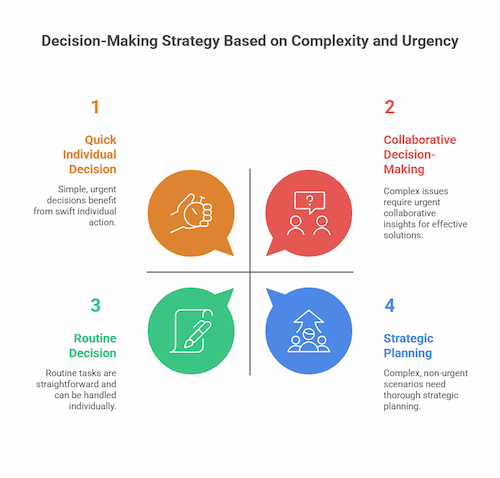
Not every choice needs the same pace. Some decisions benefit from moving quickly, while others deserve more care.
Move fast when:
- The decision is reversible
- Stakes are low
- More data will not change the direction
Slow down when:
- Ethics, safety, or reputation are involved
- The decision is irreversible
- Values are in conflict
Ambiguity becomes easier to navigate when leaders separate confusion from real risk. That clarity helps them approach tough choices with steadier judgment. The shift moves decision-making from hesitation to progress. With that focus, leaders can turn to simple tools that support clearer discussions.
Simple Tools That Bring Clarity to Tough Decisions
Leaders often reach a point where logic alone can’t guide a difficult choice. When information feels scattered, decisions can slow down and feel heavier than they should. A simple structure helps cut through the noise and highlight what matters most. With that clarity, practical tools help leaders think more clearly when situations feel uncertain.
Early in the conversation, the strategy director named a pattern that had slowed recent decisions. “We jump to risks before checking what’s real,” she admitted. Her comment revealed how often assumptions shaped reactions. The insight made it clear that a bit of structure could do more than another round of data.
Leaders benefit from using straightforward tools that frame uncertainty in manageable ways. These approaches help clarify the choice rather than complicate it.
Helpful decision tools:
- Stakeholder lenses: Identify who is affected and in what ways
- Consequence mapping: Explore second- and third-order impacts
- Reversibility filter: Clarify whether the decision can be changed
- Barbell approach: Pair bold action with protective safeguards
Many assumptions hide inside quick judgments. Asking simple questions brings them into view and prevents choices from drifting.
Questions that reveal assumptions:
- What am I assuming that might not be true?
- Which beliefs rely on old information?
- Have I checked this with someone who sees it differently?
Clarity improves when leaders define what matters most. A few categories keep the criteria grounded and realistic.
Decision criteria to set early:
- Non-negotiables
- Nice-to-haves
- Constraints
Most decisions can evolve, and treating them as adjustable reduces pressure to make them perfect. Leaders who use simple frameworks build steadier habits and move through difficult choices with less strain. With these tools in place, they are better prepared to bring others into the gray in productive ways.
Bring Others into the Gray Without Creating Chaos
Leaders make stronger decisions when they invite focused input from others. The right voices help reveal blind spots and ease the pressure of uncertainty. When collaboration is intentional, it adds clarity rather than confusion. Simple practices keep conversations productive and grounded.
Midway through the meeting, the head of customer operations named a pattern the group recognized. “We wait too long to bring people in,” she said. Her point showed how late engagement increased stress and limited helpful feedback. The conversation revealed how much smoother decisions could be when the right voices joined sooner.
Collaboration works best when leaders use a simple structure that keeps conversations focused. These practices add clarity and strengthen confidence in the final choice.
Ways to collaborate productively:
- Scenario mapping: Explore likely paths and test key assumptions
- Open ambiguity: Share what’s unclear rather than masking uncertainty
- Healthy dissent: Invite challenges before decisions are made
- Lateral insights: Bring in people outside the expected group
Some decisions benefit from shared insight, while others require a more direct approach. Knowing the difference helps leaders avoid unnecessary delays.
When to involve others:
- Multiple groups are affected
- Team expertise varies
- Assumptions need stronger testing
When to decide alone:
- Authority is clear
- Time is limited
- The decision is reversible and low-stakes
Ambiguity can create urgency that feels more emotional than strategic. Leaders who pause and name the discomfort give themselves space to think clearly. Input from others helps, but accountability still rests with the leader, and collaboration should inform the choice without turning it into a vote.
With that clarity, leaders are better prepared to anchor their decisions in the values that guide the organization.
How Values Bring Clarity to Tough Leadership Choices
Values guide leaders when tough choices feel evenly balanced. When facts don’t point clearly in one direction, values clarify what matters most. This focus strengthens judgment when logic isn’t enough. Using values early keeps decisions from drifting or feeling inconsistent.
When the discussion shifted to values, the HR director named a pattern they often missed. “We jump to tactics before asking what reflects our values,” she said. Her point showed how pressure pushed them past a critical step. Their discussion showed how grounding decisions in values could keep complex choices from drifting.
Leaders benefit from naming value tensions before choosing a path. This step keeps discussions grounded and reduces friction later.
How to work through value tensions:
- Name the tension
- Choose which value matters most in this situation
- Explain why that value should guide the decision
Different stakeholders often bring their own priorities to a decision. Returning to shared organizational values keeps those conversations anchored. Escalation is needed only when those values genuinely cannot be reconciled.
Some organizations pause or slow initiatives when shared values are at stake. Doing so may add time, but it strengthens trust and consistency. That same clarity also helps leaders choose with more confidence in uncertain moments.
When leaders name what matters and explain why, they reduce confusion and bring people into better alignment. This clarity makes difficult decisions easier for teams to understand and accept. With that foundation in place, the next step is communicating those choices clearly so people know how they were made.
How Clear Communication Strengthens Every Major Decision
Clear communication helps teams stay grounded when decisions feel uncertain. When people understand how a choice was made, they move forward with more confidence. This openness limits confusion and assumptions. Leaders who share their reasoning build stronger alignment and trust.
As the meeting drew to a close, the CIO named a pattern that had created avoidable tension. “We share the final decision but not how we got there,” she said. Her point explained why teams often felt disconnected from important choices. The moment highlighted how a bit more transparency could help people absorb tough decisions with less friction.
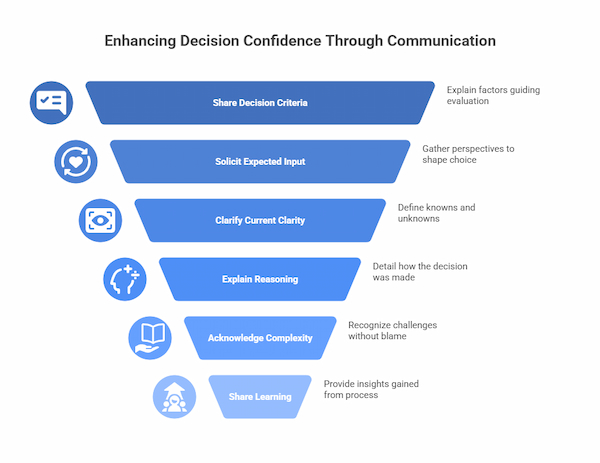
Leaders communicate more effectively when they share the purpose and limits of the decision-making process. A few simple categories help keep the message clear.
What to share while deciding:
- Decision criteria: What factors guided the evaluation
- Expected input: How others’ perspectives shape the choice
- Current clarity: What is known and what still needs confirmation
Once the decision is made, transparency helps people understand the outcome and plan next steps.
How to reinforce accountability:
- Reasoning: Explain how the choice was made
- Complexity: Acknowledge challenges without assigning blame
- Learning: Share insights gained through the process
- Adjustment: Shift direction if new information requires it
Clear communication supports teams during uncertain moments. Leaders who share their reasoning openly replace confusion with understanding and build trust through consistency. With clarity established, they are ready to guide their teams through the broader experience of leading in the gray.
What It Means to Lead Well in the Gray
Leadership becomes most visible when conditions feel unclear. Leaders who remain confident in ambiguity give their teams direction, even without complete information. This confidence develops through practice, leading to clearer choices and stronger teams.
Six months later, XentinelWave saw meaningful progress. Leaders debated more openly, escalations slowed, and decisions aligned better with shared values. Teams noticed steadier communication and fewer delays. Small habits created a noticeable shift in how they handled uncertainty.
Leading in the gray is not about finding perfect answers. It is about showing others that thoughtful progress is possible even when the path is uncertain. Leaders who practice these skills create clarity where it matters most.
If your organization wants to build stronger leadership capability in uncertain situations, Watermark Learning can help. Our courses prepare leaders to think clearly, set practical criteria, engage the right voices, and act with confidence when decisions feel ambiguous.

Jay Pugh, PhD
Dr. Jay Pugh is an award-winning leader, author, and facilitator with over 18 years of teaching and training experience. Currently serving as Head of Leadership Growth at Educate 360, he leads a robust team of external and internal facilitators who specialize in developing leadership capabilities within medium and large-scale businesses. His team works directly with business professionals, helping them become more effective leaders in their daily operations.
Dr. Pugh holds a Ph.D. in Instructional Management and Leadership, and his academic contributions include two published articles and a dissertation focusing on various educational topics. His extensive experience and academic background have established him as a respected voice in leadership development and educational management.


 New Horizons
 Project Management Academy
 Velopi
 Six Sigma Online
 Watermark Learning