

 New Horizons
 Project Management Academy
 Six Sigma Online
 TCM Security
 TRACOM
 Velopi
 Watermark Learning
 Login
Login


Key Takeaways
- Use Defines Value: Solutions matter only when people rely on them in daily work
- Adoption Starts Early: Readiness begins during analysis, not after release
- Workflow Drives Success: Fit with real work determines whether solutions last
- Readiness Is Systemic: Training alone doesn’t prepare organizations to change
- BAs Shape Behavior: Business analysis succeeds when it designs for use
Many initiatives deliver solutions that are technically correct and fully approved, yet rarely used. Teams complete the analysis, secure agreement, and move on, assuming the hardest work is behind them. Months later, the solution exists, but daily work often looks much the same.
From the project’s perspective, everything went as expected. Requirements were reviewed, stakeholders signed off, and the delivery matched the requested specifications. What often went unexamined was how the solution would fit into real work once the project’s attention disappeared.
Organizations tend to measure progress by what can be closed and documented. Requirements completed. Features delivered. Projects wrapped up. Operational change, however, unfolds later and in less visible ways, making it easier to overlook.
At XentinelWave, leadership paused over a familiar pattern: a system that met every requirement but never became part of routine operations. It raised a harder question worth asking earlier. If requirements are correct and solutions still fall short, what does success in business analysis need to account for next?
Why Adoption Is the Real Measure of Success
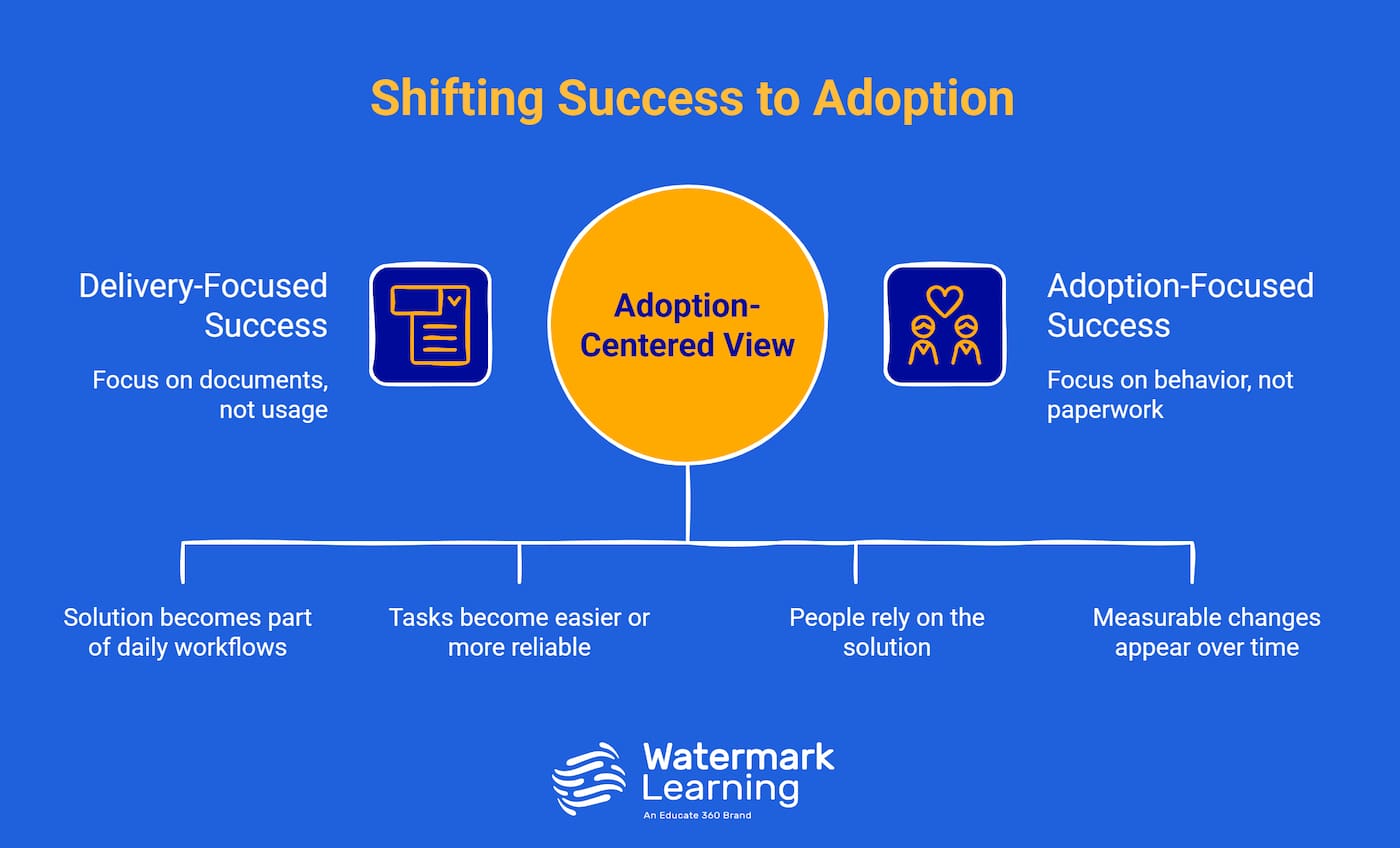
If solutions succeed only when they’re used, then success in business analysis can’t stop at delivery. It requires stepping back from documents and milestones to examine what changes once a solution enters daily work. Redefining success shifts the focus from what was produced to what improves.
For many teams, this shift becomes clearer when they compare how success has traditionally been measured with what matters once work resumes.
It’s also a difficult shift to make. Delivery timelines, approval gates, and organizational habits reinforce a narrow definition of success, even when teams know adoption matters. Changing that definition often means questioning long-standing practices under delivery pressure.
Traditional views of success often include:
- Requirements approved: Stakeholders sign off on documented needs
- Scope delivered: Features match what was requested
- Timelines met: Work completes within planned schedules
- Formal closure: Projects end once delivery occurs
An adoption-centered view looks different. Success shows up in behavior, not paperwork. A solution can be correct and still fail if people don’t trust it enough to use it when time is short, or pressure is high.
Adoption-centered success looks like:
- Consistent use: The solution becomes part of daily workflows
- Improved work: Tasks become easier or more reliable
- User confidence: People rely on the solution during real decisions
- Operational outcomes: Measurable changes appear over time
When success is defined by adoption, requirements stop being the finish line and become the starting point for how work will change. This shift reveals a harder truth: even good analysis can fall short when it doesn’t account for how people work under real conditions or pressure.
At XentinelWave, this reframing changed how leaders evaluated progress. Delivery milestones still mattered, but they were no longer treated as proof that work had improved.
This perspective makes it easier to recognize the subtle ways adoption begins to fade after delivery, which is where many well-designed solutions start to lose momentum.
Where Good Solutions Start to Lose Momentum
Once success is viewed through the lens of adoption, patterns emerge about why well-designed solutions fall short. The breakdown rarely happens at a single point. Instead, it develops as solutions encounter the realities of daily work, competing priorities, and unclear expectations.
These breakdowns show up in a few consistent ways, especially when solutions meet real-world conditions.
Common breakdown points include:
- Workflow mismatch: Designed processes differ from how work is done
- Usability barriers: Too many steps or unclear task flow
- Role confusion: Unclear ownership or decision authority
- Confidence gaps: Users are unsure when to rely on the solution
These issues often surface early for attentive teams. Hesitation during walkthroughs, questions about use, or mentions of workarounds signal deeper concerns. When those signals are dismissed as temporary, adoption risk grows.
Over time, small breakdowns shape behavior. Workarounds become normal. Partial use is accepted as good enough. Silence is mistaken for success because complaints fade, even as value erodes.
These breakdowns rarely feel dramatic in the moment. They surface as reasonable adjustments people make to keep work moving. Preventing that pattern requires shaping adoption earlier, while assumptions are still open to challenge.
When XentinelWave examined similar patterns, the absence of complaints initially suggested stability. Over time, it became clear that silence often meant people had worked around the solution rather than addressed it.
Recognizing these early signals raises an important question: how much of this risk can be addressed before delivery even begins?
How Requirements Shape Adoption More Than You Think
Understanding where adoption breaks down leads to a more important question: how much of that risk can be addressed earlier? The requirements phase has a greater influence on adoption than many teams realize. Decisions made here shape whether a solution feels usable once project support fades.
During analysis, certain requirement qualities make them easier to translate into sustained use.
Adoption-focused requirements emphasize:
- Workflow alignment: Requirements reflect how tasks flow day to day
- Role awareness: Designs acknowledge who decides and who acts
- Scenario validation: Use cases reflect realistic conditions
- Clarity of ownership: Responsibility is visible within the solution
Designing for behavior also means reducing unnecessary effort. Extra steps, unclear prompts, and poorly timed information push people back to older habits. A simple question often surfaces this risk early: How will this feel to use when timelines are tight and support isn’t nearby?
When analysis reflects how work is performed rather than how it’s imagined, solutions earn trust more quickly. Analysts who focus on behavior, decision points, and ownership reduce the need for correction later. XentinelWave found the strongest requirements were shaped through observation and discussion, not just documentation review.
Even with stronger requirements, adoption still depends on whether the organization is prepared to support the solution once it’s in use, which leads directly to the question of readiness.
When a Solution Is Ready, but the Organization Isn’t
Even well-designed solutions struggle without organizational readiness. Often treated as late-stage training or communications, readiness ultimately determines whether people feel confident using a solution once support steps back.
Readiness depends on four connected dimensions:
- Operational readiness: The work can run consistently
- Behavioral readiness: People use the solution as intended
- Technical readiness: Systems perform reliably
- Decision readiness: Users know when and how to act
Gaps are hard to spot early because everything appears stable during planning. Issues surface later, as time pressure increases and support recedes, and confidence often drops before metrics reflect a problem. This raises an uncomfortable question many teams avoid: who owns adoption once delivery is complete? Without clear ownership, readiness gaps persist even when everyone agrees they exist.
Readiness becomes visible when people know what to do, trust the tools at hand, and feel supported in using them. Without those conditions, training fades, and old habits return.
At XentinelWave, readiness gaps only became clear once support stepped back and teams were expected to operate independently.
Viewed this way, readiness highlights how directly business analysts influence whether a solution takes hold or fades after release, setting up the next conversation about what analysts can do differently.
Why Analysts Are Central to Lasting Change
When readiness is treated as a condition rather than an event, the role of the business analyst expands. Analysts are no longer just capturing needs; they are helping the organization prepare for change. Their work connects design decisions to how people will act once the solution is in place.
This influence shows up through a few repeatable behaviors that shape adoption before and after release.
Effective adoption practices include:
- Workflow-based requirements: Capture how the solution fits into work
- Scenario walkthroughs: Validate use under realistic conditions
- Usability observation: Watch how people interact with designs
- Pilot testing: Expose issues before broad release
By staying connected to how solutions are used after release, analysts help organizations move beyond intention and into sustained change. Over time, this approach reveals patterns that explain why some efforts stabilize while others stall. Those lessons are clearest when requirements succeed, but adoption doesn’t.
When Everything Is Right on Paper
Despite best intentions, many organizations encounter solutions that meet expectations on paper but struggle in practice. These situations aren’t edge cases. They’re predictable outcomes when workflow clarity and decision confidence go unexamined.
When teams look closely, the same underlying causes tend to surface repeatedly.
Common causes include:
- Workflow gaps: Designs overlook daily realities
- Decision ambiguity: Users are unsure when to rely on the system
- Confidence issues: Inconsistent outcomes undermine trust
Teams often misdiagnose these situations. Low usage is labeled as resistance. Complaints are dismissed as temporary discomfort. More enforcement or reminders are introduced, even though the underlying issue hasn’t changed.
These situations show that failure isn’t always the result of poor analysis or missed requirements. More often, they reflect unanswered questions about use. Once those gaps are acknowledged and corrected, adoption begins to settle. The early signs of progress are subtle but consistent.
XentinelWave reached this point only after shifting the conversation away from compliance and toward confidence in daily work.
Understanding these patterns helps teams recognize what adoption looks like as it stabilizes.
What Successful Adoption Looks Like in Real Work
As adoption takes hold, success becomes easier to recognize. It shows up gradually through behavior rather than formal reporting. These signals reflect whether the solution has become part of how work is done.
Over time, a small set of observable patterns makes adoption clear.
Clear signals include:
- Unprompted use: People rely on the solution naturally
- Stable workflows: Tasks settle into consistent patterns
- Disappearing workarounds: Manual alternatives fade away
- Decision confidence: Users act without hesitation
A useful way to capture this shift is simple: delivery creates certainty on paper, while adoption creates certainty in behavior. When behavior stabilizes, value follows.
When people rely on a solution without reminders or reinforcement, the work has changed. For many teams, the most effective shift begins when they ask how work should feel six months after release, not just how it should function on day one.
At XentinelWave, this shift became clear when teams stopped discussing the tool and started discussing outcomes instead.
These signals help organizations distinguish between delivered solutions and changes that truly stick, which is where the broader value of business analysis becomes visible.
Turning Requirements Into Lasting Change
Adoption emerges through usability, clarity, and alignment with work. Business analysts enable change by designing for behavior and decision-making, not just documentation. When readiness is addressed early, solutions are more likely to become part of daily work rather than something teams work around.
Watermark Learning helps teams build this capability through practical, role-focused learning. By strengthening judgment, leadership, and real-world application, analysts and leaders are better prepared to design solutions that hold up after delivery and lead to sustained use.
For teams seeing capable analysis work fall short of lasting change, this is often the moment to pause and reassess. What would adoption look like if analysts were better equipped to design for it from the start?
Watermark Learning works with organizations to answer that question in practical ways. Reaching out isn’t about fixing what’s broken, but about strengthening what already exists so it delivers lasting results.
Related Change Management Training:
- Change Management Foundation Certification Prep (APMG)
- Change Management Practitioner Certification Prep (APMG)
- Organizational Change Management
- Agile Change Agent


 New Horizons
 Project Management Academy
 Velopi
 Six Sigma Online
 Watermark Learning