

 New Horizons
 Project Management Academy
 Six Sigma Online
 TCM Security
 TRACOM
 Velopi
 Watermark Learning
 Login
Login


Key Takeaways
- Tool, Not a Crutch: Using AI without evaluating its output is a habit, not leadership
- Where Leaders Add Value: High-stakes moments demand judgment, empathy, and accountability AI cannot provide
- Judgment Is Learnable: Knowing when not to use AI is a trainable skill
- Low-Stakes Practice: Developing judgment in small decisions prepares teams for the ones that matter
- Leadership Readiness: Organizations that develop judgment at scale build their strongest leaders
You’re in the middle of a messy situation at work. Maybe a team conflict has been simmering for weeks, or a client relationship just hit a wall, or you’re deciding between two candidates for an important role. You open an AI tool, describe the situation, and get back a polished response in seconds.
But something feels off: the context is missing, the relationship history isn’t there, and nobody told you how to decide what to do with what the tool just gave you. The output looks right on the surface. Whether to use it is a different question entirely.
Right now, everyone is getting the same message: use AI, work faster, stay current. The tools arrived, the training followed, and the pressure to adopt is increasing. But the guidance stops there. Nobody is teaching people how to evaluate what AI gives them, when to trust it, and when to set it down and lead.
Read on to understand why developing leaders who know how to use AI well, and when not to, is no longer optional. The organizations that get this right will build teams that are faster, more trusted, and better equipped to lead.
You’re Using AI. But Are You Leading With It?
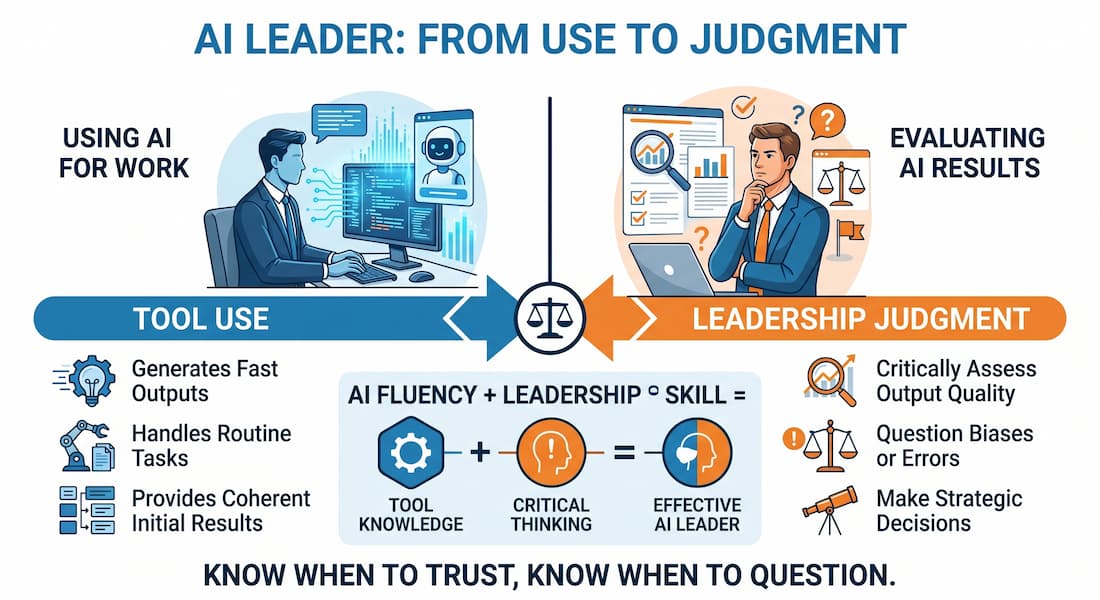
Using AI as a tool and relying on it as a substitute for judgment are two different things. One extends what you can do. The other replaces a skill you should build. Right now, many leaders are somewhere in between, and their organizations haven’t given them a framework for closing that gap.
Fluency in these tools is becoming a baseline expectation across industries. According to a January 2025 McKinsey report, 34% of employees expect generative AI to handle more than 30 percent of their daily work within the next year, more than twice the share of C-suite executives who believe employees will reach that level. If the output is fast, coherent, and good enough, why slow down?
Many leaders have had at least some AI training. Decision-making guidance is what’s missing. Someone taught them to use AI tools, but not how to evaluate what the tool produces. Without this skill, they end up trusting results they aren’t equipped to question.
People who use AI most effectively aren’t the ones with the most tool knowledge. They’re the ones who know when to trust the output and when to question it. Knowing the difference isn’t a technical skill. It’s a leadership one.
Where AI Does Its Best Work
Not every task requires a human decision. AI performs well at pattern recognition, data synthesis, and routine consistency. The people who get the most out of it know that and use it accordingly. Knowing where AI fits and where it doesn’t is what separates deliberate use from default use.
In practice, AI adds value in situations like these:
- Synthesizing meeting notes: Pulling together key decisions, action items, and themes from a long discussion
- First-pass report drafts: Generating a structured starting point that a human then refines with context
- Flagging scheduling conflicts: Managing coordination across calendars and identifying overlaps automatically
- Researching background: Surfacing relevant information before a meeting, client call, or presentation
AI handles these tasks well, freeing up time for work that requires human interaction. Knowing where AI ends and human involvement begins is what good judgment requires.
People who use AI well don’t rely on it for everything. They’re clear about what the tool can and can’t do. Being clear about the distinction is what allows efficiency and judgment to coexist.
Where Human Judgment Has to Lead
Some moments at work can’t be delegated to a tool. They need someone who understands the full context, is accountable, and can respond to what the situation requires. How leaders handle these moments is what builds lasting trust with their teams.
Across nine studies involving more than 6,000 adults, researchers found that people rated empathetic messages as more supportive when they believed a human had written them, even when the content was word-for-word identical. The effect was strongest for responses conveying emotional sharing and care. It weakened when participants suspected AI had played a role, even without being told.
Even the suspicion that AI was involved was enough to change how people felt about it. When people feel heard by a person, the connection carries weight that a generated response doesn’t.
Three situations stand out as places where judgment leads:
- Difficult team conversations: When conflict, performance, or trust is on the line, the person across from you needs a leader who has read the context, considered the relationship, and chosen to show up with accountability
- Nuanced hiring decisions: The most important hiring calls involve things no AI saw: how someone handled ambiguity, how they responded to challenges, what the team needs that a resume can’t capture
- Client moments when trust is built: At certain points in a client relationship, a person needs to feel heard. A polished AI response can’t do what a direct human conversation does in that moment.
Situations like these play out in organizations every day. What connects them is that decision-making belongs to a person, not a tool. What they require is judgment, and anyone can build it.
How to Build the Skill Nobody’s Teaching You
Judgment gets sharper with practice. Most leaders sense when something doesn’t feel right. What they lack is a framework for acting on it. Judgment means knowing when to stop, assess the output, and make the call yourself.
Developing judgment skills doesn’t happen by accident. It requires teaching leaders to recognize the situations that need a human decision, not speed alone, and to act on that recognition decisively.
These are the learnable skills that strengthen human judgment:
- Reading context and dynamics: Recognizing what’s driving a situation beyond what any prompt can capture, including relationship history, team pressure, and unspoken concerns
- Evaluating AI output critically: Assessing what the tool gave you, what it missed, and whether those gaps matter
- Identifying emotional and relational stakes: Knowing when a situation carries weight that requires a human response, not a generated one
- Communicating decisions that build trust: Delivering conclusions in ways that acknowledge the people affected, not just the outcome reached
- Owning accountability: Taking responsibility for decisions a tool helped shape, without hiding behind the output
Putting these skills to work takes practice. Here are three habits that help build them over time:
- Pause before defaulting: Ask whether the situation requires something AI can’t see. If it does, lead first
- Ask the right question: Ask what would be lost if a human didn’t make this call. If the answer matters, make it yourself
- Debrief after the fact: After a meaningful decision, evaluate whether the output accounted for what mattered
Think of these less as steps and more as ways to train awareness across leadership teams. Over time, reading situations becomes second nature. Organizations that build these habits at scale gain something more valuable than efficiency. They develop leaders that know when to use AI and when the situation calls for them instead.
Start with small decisions and sharpen judgment as you go. Leaders who build this habit don’t just make better calls. They create the momentum that moves organizations forward.
Leadership Skills Are What Make AI Work
Using AI well and leading with judgment where it matters is what effective leadership looks like now. The organizations that build this skill across their teams aren’t slower. They’re more reliable, more trusted, and more effective than the ones that move fast.
Leadership teams that build judgment skills now will be the ones who use AI where it serves them best and lead where it can’t. It starts with a single decision, handled the right way, for the right reasons. Do that enough times, and it stops being a practice and becomes a leadership habit.
Watermark Learning develops leaders who understand that the most valuable skill in an AI-driven workplace isn’t only about knowing how to use the tools. It’s about recognizing where the tool stops and the leader begins.
Is your organization building that judgment?
Explore Watermark Learning’s leadership development programs and build the skills your leadership teams need.
Recommended Training:
- Thinking with Critical Insight
- Foundations of Emotional Intelligence
- Making the Right Decisions Under Pressure

Jay Pugh, PhD
Dr. Jay Pugh is an award-winning leader, author, and facilitator with over 18 years of teaching and training experience. Currently serving as Head of Leadership Growth at Educate 360, he leads a robust team of external and internal facilitators who specialize in developing leadership capabilities within medium and large-scale businesses. His team works directly with business professionals, helping them become more effective leaders in their daily operations.
Dr. Pugh holds a Ph.D. in Instructional Management and Leadership, and his academic contributions include two published articles and a dissertation focusing on various educational topics. His extensive experience and academic background have established him as a respected voice in leadership development and educational management.


 New Horizons
 Project Management Academy
 Velopi
 Six Sigma Online
 Watermark Learning