

 New Horizons
 Project Management Academy
 Six Sigma Online
 TCM Security
 TRACOM
 Velopi
 Watermark Learning
 Login
Login


Key Takeaways
- Assumption Decay Breaks Plans: Valid assumptions lose accuracy as conditions shift over time
- Criticality vs. Evidence Mapping: Two axes reveal which assumptions demand immediate testing
- Facilitation Shapes Discovery: Structured group exercises expose hidden assumptions before plans move forward
- Cascading Assumption Chains: One failed assumption can collapse an entire dependent chain
- Handoff Documentation Standards: Passing assumption maps with the work prevents inherited blind spots
Plans rarely collapse because of bad strategies. More often, they fail because nobody wrote down what had to be true for the strategy to work. Solid data, reasonable timelines, aligned stakeholders. None of it matters if the assumptions underneath were never examined.
At XentinelWave, a cross-functional initiative to modernize internal reporting ran into exactly this. The technology was in place and the process was well documented, but no one had examined whether the teams receiving the new reports would trust them enough to act on them. Discovering that assumption earlier would have changed the outcome entirely.
Many organizations face some version of this. Tools exist to manage execution risk, but the assumptions that shape a plan in the first place often go undocumented. They live in someone’s head, inside a slide deck, or buried in a scoping conversation from six months ago.
Assumption mapping addresses this directly. It exposes what a plan depends on before those dependencies become expensive surprises. For business analysts, it’s one of the most practical skills available and one of the least consistently applied. What follows covers how it works, why it matters, and what experienced analysts wish they had learned earlier.
The Question Every Plan Should Start With
Every plan depends on something being true. Assumption mapping is the practice of identifying and documenting those dependencies before the plan moves forward. It doesn’t predict the future. It simply asks: what must be true for this to work?
Any plan, no matter how well-built, depends on more assumptions than first appear. Some are obvious. Others are well-known from habit but never written down. Some are so deeply embedded in how a team thinks that they never get questioned. And others haven’t been encountered yet.
The practice is often confused with tools BAs already use. Each one addresses a different part of the planning problem, but none of them ask what a plan is depending on before it moves forward. Assumption mapping fills that gap.
The confusion usually comes down to three tools that address adjacent problems but stop short of asking what a plan depends on.
The Gap Each Tool Leaves
- Risk registers: Track what could go wrong, not what has to be true
- SWOT analysis: Weigh internal and external factors, not underlying dependencies
- Scenario planning: Explore possible futures, not the assumptions underneath them
Each of these tools is valuable in the right context. The gap isn’t in what they do. It’s in what they don’t ask, and assumption mapping is built around exactly that question.
Knowing what a plan depends on lets teams decide which assumptions deserve scrutiny and which are safe to accept. But knowing where to start requires understanding what an assumption looks like in practice.
What an Assumption Looks Like
Planning conversations have a habit of treating assumptions as background noise. They’re the things everyone agrees on without discussion, the conditions that feel so obvious they don’t need questioning. But assumptions come in different forms, and recognizing them is the first step toward managing them.
Business analysts encounter three types most consistently. Each one shows up differently in a plan and carries a different kind of risk.
Knowing which type you’re dealing with is what determines how you test it.
The Three Types of Assumptions
- Structural assumptions: How the business or market works, often treated as fixed
- Behavioral assumptions: How customers, stakeholders, or teams will respond
- Dependency assumptions: What else must be true for the plan to work
Each type calls for a different testing approach. A structural assumption might require market data, while a behavioral one might call for a pilot or user interview. Dependency assumptions often require direct communication with another team.
Not every assumption deserves the same level of attention, and two questions help sort them out: How critical is the assumption to the outcome? and How much evidence supports it? That’s exactly what the map is built to show.
Understanding them matters as much for the people who manage analysts as it does for the analysts themselves.
What This Means If You Manage BAs
Some managers approve assumption mapping work without fully understanding it. The environment leaders create around the practice matters as much as the practice itself. Teams raise weak assumptions when they feel safe doing so, and that starts with how leaders respond when problems get raised.
The manager’s role here isn’t technical. It’s cultural. Teams need to know that identifying a weak assumption is considered good work, not second-guessing the plan or slowing things down.
Good assumption mapping work has recognizable qualities from a leadership perspective.
The Conditions That Make Mapping Work
- Visible assumptions: Plans include documented assumptions, not just conclusions
- Rewarded candor: Team members raise concerns without fear of pushback
- Active coaching: Managers use assumption maps as a quality review tool
- Healthy skepticism: Plans with no visible assumptions are treated as a warning sign
None of these conditions requires a formal process change. They require a shift in what managers signal matters, and the shift starts with how they respond when an analyst raises a problem early. Organizations that treat early problem-raising as good work are the ones where assumption mapping becomes a consistent part of how they plan.
Managers who understand assumption mapping don’t just approve the work. They make it safer for their teams to be honest, and that honesty is what makes the practice worth doing.
How to Build an Assumption Map
Not all assumptions carry equal weight, and treating them as if they do wastes time. The 2×2 assumption map plots assumptions on two axes, criticality (vertical) and evidence (horizontal), by asking two questions of each: how critical is this assumption to the outcome, and how much evidence supports it?
A 2×2 map produces four quadrants, and each one calls for a different response.
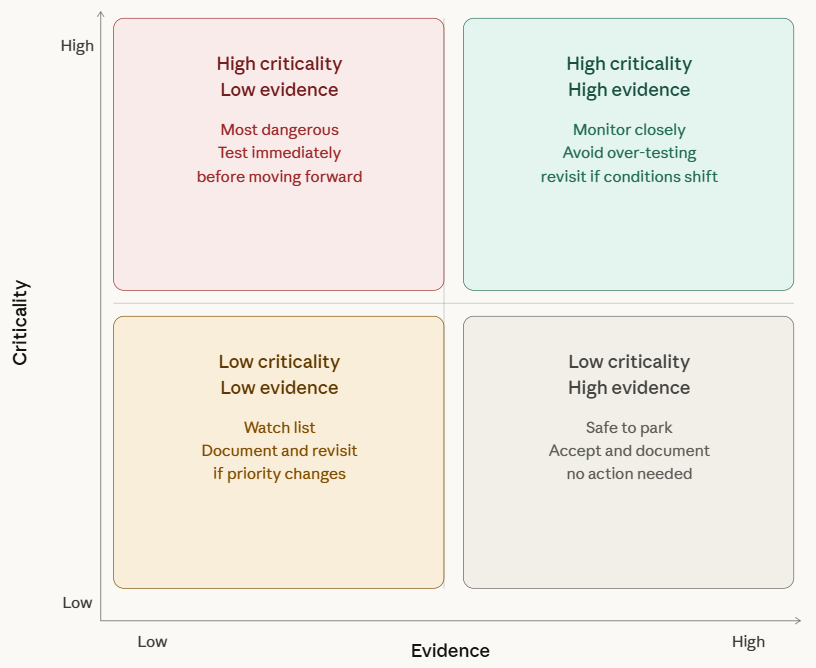
High criticality with low evidence needs immediate testing. High criticality with high evidence should be monitored but not over-examined. Low criticality with low evidence goes on a watch list. Low criticality with high evidence can be safely set aside.[BK1]
Running a mapping session requires structure, but not complexity. A small group, a clear facilitator, and a shared format are enough to get started.
How to Run an Assumption Mapping Session
- Identify them first: Brainstorm without filtering before evaluating anything
- Articulate them clearly: Frame each as a testable statement with clear failure conditions
- Plot them on the map: Place each assumption in the appropriate quadrant
- Prioritize next steps: Decide which assumptions to validate, monitor, or flag as blockers
The BA’s role in this process is facilitation, not authority. The goal is to draw out what the group collectively knows, expose the gaps, and create a shared picture of where the plan is most exposed. A well-written testable statement might read: “We are assuming customers prefer self-service, and we will know this is wrong if adoption falls below 30% in the first 60 days.”
An assumption log that sits in a shared drive and never gets opened isn’t useful. Each quadrant needs clear follow-up actions attached, and the map should be treated as a starting point for decisions, not a finished deliverable. Analysts who build this habit develop better instincts over time, and those instincts are what make the difference when plans come under pressure.
What Experienced BAs Wish They Had Known Earlier
The analysts who get the most out of assumption mapping are usually the ones who treated every project as an opportunity to sharpen their instincts. Those instincts tend to reveal the same patterns, regardless of industry or project type.
Understanding those patterns early doesn’t eliminate the learning curve, but it shortens it considerably. Four of them come up consistently across industries and project types, and each one is worth understanding before they show up in your next project.
Four Patterns Every BA Should Recognize
- Assumption decay: Valid assumptions lose accuracy as conditions change over time
- Cascading assumptions: One failed assumption can collapse an entire dependent chain
- Assumption politics: Some go untested because they challenge a leadership narrative
- Mapping under pressure: A lean session focused on high-criticality assumptions beats no session
Recognizing these patterns is only part of the picture. Knowing where the practice itself tends to break down is what keeps it delivering value over time.
Pitfalls Worth Knowing in Advance
- Over-mapping: Excessive analysis buries the insights that matter
- Mapping without testing: Treating the map as a final artifact instead of a decision tool
- The checkbox trap: Adopting assumption mapping as a process requirement, not a thinking tool
Both sets of patterns point to the same opportunity. Analysts who stay engaged with the thinking behind the map are the ones who get the most out of the practice, and that engagement matters all the way through to the handoff.
How Experienced BAs Handle the Handoff Differently
The teams that handle handoffs well know that the map is only valuable if it travels with the work. They treat the handoff as part of the project, not the end of it, and make sure the incoming team inherits context, not just conclusions.
Continuity depends on more than documentation. The incoming team needs the reasoning behind the plan, not just the plan itself, and the assumption map is what carries that reasoning forward.
A proper handoff package goes beyond the map itself. Several things need to travel with the work to give the incoming team the full picture they need to move forward without gaps.
What a Proper Handoff Package Should Contain
- The assumption map itself: Including quadrant placement and the reasoning behind each decision
- Linked risk monitoring: High-criticality assumptions connected directly to implementation tracking
- Context notes: A brief explanation of why specific assumptions mattered and what triggered them
- Outstanding validations: Assumptions identified but not yet tested before the handoff
Including these elements changes what the receiving team inherits. Instead of a plan with invisible dependencies, they get a plan with its assumptions documented, its risks identified, and its gaps already accounted for.
At XentinelWave, a technology modernization initiative ran into exactly this during a leadership transition. The incoming team had the documentation but not the assumption context, and decisions that seemed arbitrary only made sense weeks later.
Teams that get the handoff right don’t just pass along a plan. They pass along the reasoning behind it, and that reasoning is what gives the next team the foundation to build on rather than starting over.
Risk Isn’t the Enemy. Invisibility Is.
Assumption mapping isn’t about pessimism. It’s about honesty. Plans built on visible assumptions are easier to defend, easier to adjust, and far less likely to fail quietly in ways nobody saw coming.
The strongest analysts don’t eliminate uncertainty. They make it visible so organizations can manage it deliberately. An assumption that’s documented and monitored is a manageable risk. One that nobody wrote down is a blind spot waiting to be discovered at the worst possible moment.
At Watermark Learning, we help analysts and the leaders who manage them build this discipline into how they plan and execute. Our training gives teams the frameworks to test the assumptions that matter and carry that clarity through every stage of a project.
Is your team building plans based on assumptions nobody has written down yet?
Reach out to Watermark Learning today to start building that discipline together. Start with one session, one map, and a team of analysts who uncover assumptions before they undermine your next plan.
Recommended Training:


 New Horizons
 Project Management Academy
 Velopi
 Six Sigma Online
 Watermark Learning