

 New Horizons
 Project Management Academy
 Six Sigma Online
 TCM Security
 TRACOM
 Velopi
 Watermark Learning
 Login
Login


Key Takeaways
- Interpretation Gap: Every team member’s filters create different mental models of “done”
- System Over Motivation: Inconsistent execution usually points to a structural gap, not commitment
- Attention as Leadership: Monitoring interpretation instead of progress closes the gap before it widens
You sent a well-researched task brief to your team with a defined scope, timeline, and success criteria. Two weeks later, the deliverables came in, and you stared at them, wondering if anyone had read the same document. Every team member had produced something different. Nobody ignored the brief. Rather, they each interpreted it through their own lens and came back with a different answer. The brief was clear. The interpretations weren’t.
If that scene feels familiar, you’re in good company. Most leaders who struggle with inconsistent results aren’t giving bad direction. They’re giving direction that means something different to every person who receives it. The gap between intent and outcome isn’t a communication failure in the traditional sense. Something more predictable is happening.
The good news is that predictable problems have addressable causes. Understanding where interpretation diverges, and what leaders can do about it before results come in, is where consistent execution starts.
What Your Team Hears When You Give Direction
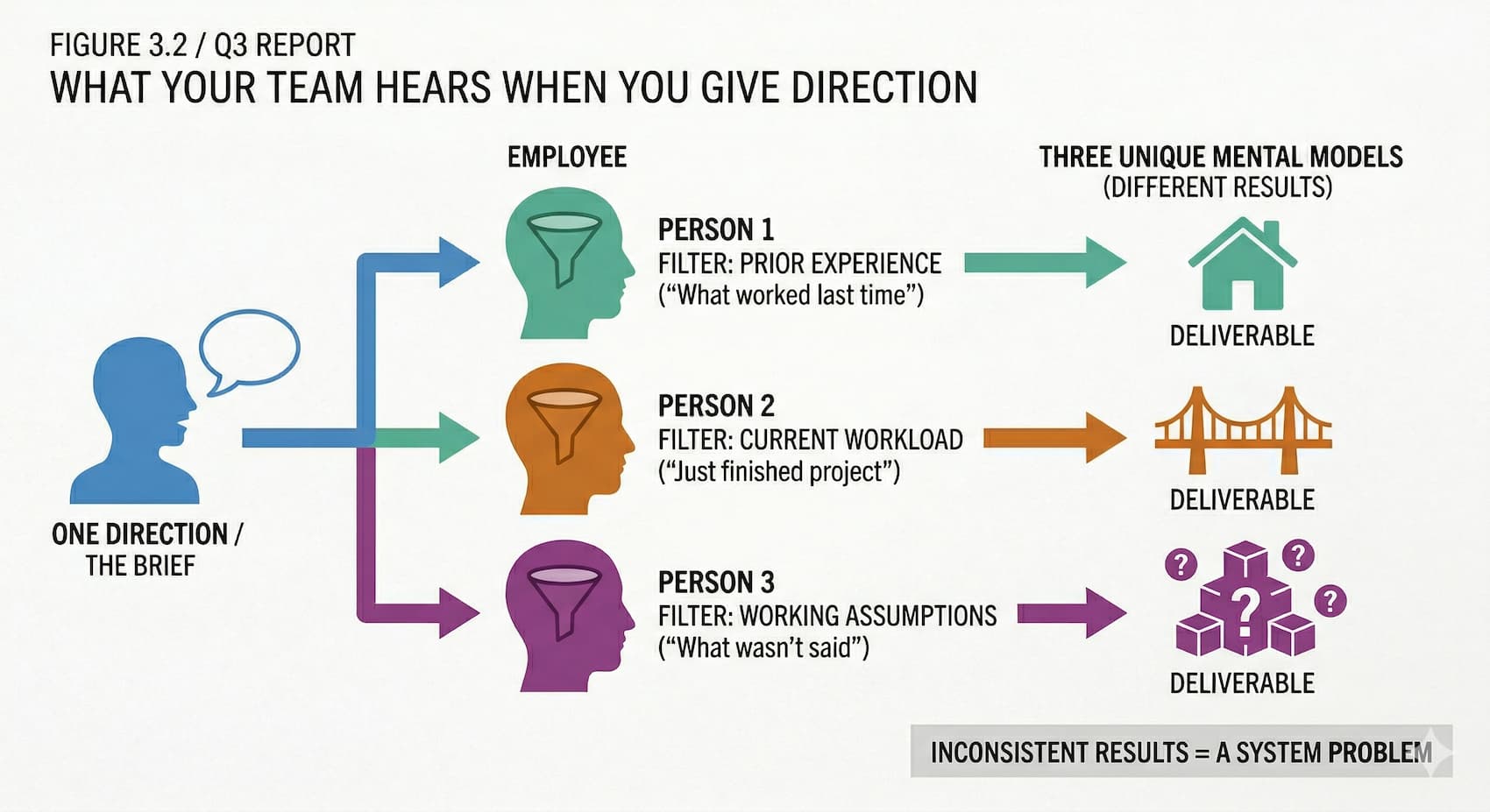
Direction doesn’t travel intact from one mind to another. Before it becomes action, it passes through each person’s prior experience, current workload, and working assumptions about what “good” looks like. Two people can read the same brief and build entirely different mental models of what a successful deliverable means.
One person fills in the gaps with what worked last time. Another interprets the ask through the lens of the project they just finished.
A third focuses on what wasn’t said and makes a judgment call. None of them is trying to get it wrong. They do what people do: construct meaning from the information available, then act on it.
Every team member has unique filters they apply to every new brief they receive. They don’t reset when a new project starts; their filters shape how the brief gets read from the first sentence.
A detailed brief doesn’t close the interpretation gap. It gives each person more to work with when they build their own version of what you asked for.
When individuals’ interpretation varies this predictably, inconsistent results stop being a people problem. They become a system problem, and identifying the right one is where leaders need to start.
Stop Diagnosing Motivation and Start Diagnosing the System
The initial instinct when outputs don’t match expectations is to question effort. Someone wasn’t paying attention. Another person didn’t care enough. A third dropped the ball. The diagnosis is usually wrong and costly because it points leaders in the wrong direction.
A team that gets pushed harder when it needs clearer criteria will produce the same inconsistent results, just faster.
Execution gaps tend to cluster around three structural conditions:
- Unclear success criteria: Without a shared definition of done, people come to different conclusions
- Missing capability: People understand the task but lack the skills to execute it consistently
- Absent feedback loop: No check exists to catch misalignment before results arrive
Typically, the issue of unclear criteria first shows up when team members ask questions late, or worse, don’t ask at all, and guess. Missing capability is harder to spot. People are putting in the work, but the results still vary because they don’t have the necessary skills yet. A missing feedback loop is the most invisible of the three. By the time you see the problem, it’s already in the deliverable.
Any one of these conditions puts consistent results at risk. When two or three are present at the same time, they compound each other, widening the gap.
Leaders are trained to manage what they can see. Effort is visible. Attitude is visible. The gap between what was asked and what someone understood rarely is.
When leaders diagnose motivation instead of structure, they often add pressure where the team needs clarity. The cycle repeats, results stay inconsistent, and the real issue stays buried until someone decides to look at the system instead.
Build the Conditions That Turn Direction into Action
Most execution problems don’t start with bad direction. They start with what leaders stop paying attention to once direction is given. Shifting that attention early is what keeps misalignment from gaining momentum.
Many leaders track progress. Milestones, updates, and status checks all answer the question “how far along are we?” A more useful early question is “what does each person think we’re building?”
Checking interpretation early takes almost no time. Catching misalignment after two weeks of work costs far more.
The reason most leaders don’t make this shift isn’t a lack of awareness. It’s that progress is visible, and interpretation isn’t. Project tools track milestones. Status updates report completion.
Nothing on a dashboard tells you whether two people on your team have built completely different pictures of what they’re delivering. The visibility gap is what makes interpretation easy to overlook until the results come in wrong.
Closing that visibility gap requires deliberate practice, not just good intentions.
- Run an early check-in specifically on interpretation, not on progress. Ask each person what they understand the deliverable to be and what success looks like from their perspective. The goal isn’t to quiz anyone. It’s to surface the gaps before they become deliverables.
- Make the definition of “done” visible and specific enough that two people reading it independently would arrive at the same picture. That might mean a one-paragraph success description at the top of every project brief, written in plain language and reviewed by the team before work begins.
- Normalize course-correction before delivery. When teams know that adjusting direction mid-project is expected and welcomed, they speak up instead of masking problems. A leader who responds to early recalibration with curiosity rather than frustration sends a clear signal: catching a problem early is not a failure, it’s the system working.
What leaders choose to pay attention to shapes how direction turns into action. A leader who monitors interpretation creates the conditions for alignment. A leader who monitors only progress misses misalignments too late to address them without cost.
Direction Is Only Half the Work
Getting direction right is the first step. What happens after you send it determines whether your team arrives at the same destination. Each person brings it to life through their own lens, and without deliberate conditions to align those lenses, variation is the predictable result.
Interpretation check-ins, visible definitions of done, and normalized course-correction won’t eliminate inconsistency entirely, but together they shift the odds in your favor every time you use them.
When results come in inconsistently, resist the instinct to look backward and instead ask what each person thought success looked like. Answering that question points toward the real gap and toward the conditions a leader can build.
Watermark Learning works with teams and leaders who want to close the space between good direction and reliable execution. Leadership development training builds the skills leaders need to ensure their entire team starts every project with the same picture of what a completed task should look like.
Ready to stop diagnosing effort and start building the system that gets results?
Explore Watermark Learning’s leadership training and give your team a foundation where consistent execution is the norm, not the exception.
Recommended Training:
- Critical Facilitation Skills for Leaders
- Accomplishing the Results You Want
- Developing Interpersonal Skills

Jay Pugh, PhD
Dr. Jay Pugh is an award-winning leader, author, and facilitator with over 18 years of teaching and training experience. Currently serving as Head of Leadership Growth at Educate 360, he leads a robust team of external and internal facilitators who specialize in developing leadership capabilities within medium and large-scale businesses. His team works directly with business professionals, helping them become more effective leaders in their daily operations.
Dr. Pugh holds a Ph.D. in Instructional Management and Leadership, and his academic contributions include two published articles and a dissertation focusing on various educational topics. His extensive experience and academic background have established him as a respected voice in leadership development and educational management.


 New Horizons
 Project Management Academy
 Velopi
 Six Sigma Online
 Watermark Learning