

 New Horizons
 Project Management Academy
 Six Sigma Online
 TCM Security
 TRACOM
 Velopi
 Watermark Learning
 Login


Key Takeaways
- Know your home base: understand your communication strengths and how others experience them
- Prepare beyond the content: anticipate how different people will receive your message
- Engage multiple audiences: build one message that speaks to different priorities and concerns
- Build trust through behavior: use curiosity, adaptability, and dialogue to earn credibility
- Anticipate concerns: addressing what a room may need can signal judgment
A leader walks into a meeting with a well-prepared presentation. The data is accurate, the recommendations are clear, and the supporting information is thorough. Yet some participants seem engaged while others remain quiet, distracted, or unconvinced.
The leader communicated the information. But did they engage the audience?
Leaders tend to prepare the content and give less attention to who they are, how they communicate, and how different people will receive the message.
Preparing for a meeting is harder because the participants need different things. One may want facts and a direct recommendation. Another needs the context. A third is concerned about how the decision affects their team, and a fourth wants details about implementation.
Why Doesn’t a Good Message Always Earn Credibility or Trust?
Even a well-built message can fall short. The strengths that make someone credible and the signals another person uses to recognize credibility don’t always line up. A business analyst might show competence through extensive detail, but an executive who needs a timely recommendation could read that same detail as uncertainty.
The mismatch matters because strong trust in leadership goes hand in hand with engagement. Gallup reports that U.S. employees who strongly trust their organization’s leadership are 3.7 times as likely to be engaged, and roughly one in five say they do.
Writing in Harvard Business Review, Cuddy, Kohut, and Neffinger argue that leaders who begin with warmth build the trust that makes people open to their message. Wharton Executive Education names warmth and competence as the two traits most tied to trust. It also cautions that even trustworthy people have to earn trust from the colleagues around them.
Earning trust happens through behavior, and colleagues can read it differently:
- Directness: confidence to one listener, insensitivity to another
- Speed: decisiveness to one, haste to another
- Small talk: warmth to one, wasted time to another
- Credentials: expertise to one, distance to another
Being trustworthy means giving people good reasons to trust you, and credibility depends on whether they see those reasons. Credibility differs from the power to decide, which can depend on authority and timing.
Rank, familiarity, past relationships, and company culture also shape how people take in any message.
Test this against your own communication:
- Your first read: When a well-prepared message gets a lukewarm response, do you look at the content first or at how you came across?
- Your strengths: Which of these has someone read differently than you intended: directness, speed, small talk, or credentials?
With so many factors at play, it helps to start by knowing why people listen to you.
Name the Reasons People Listen to You
Two questions need answering before you speak: what gives people a reason to trust you, and how your strengths show up in your behavior. The first deserves more attention than it usually gets. It goes beyond job title and expertise to a more personal question: why does anyone listen to me?
Many leaders call authenticity essential to leadership, and the answer starts with knowing what makes you an effective communicator. Every leader has a communication home base: the tendencies, strengths, values, and behaviors that shape how they interact with others.
Some leaders communicate through directness and decisive action. Others build relationships through thoughtful listening, empathy, enthusiasm, or careful attention. Each style offers strengths that work best when leaders know how to use them.
A few questions can help you take stock of your strengths:
- Honesty: How openly and directly do you share what you think?
- Integrity: How consistently do your actions match what you say you stand for?
- Reliability: Can others count on you to follow through?
- Listening: Do people feel heard when they talk with you?
Leaders express these strengths in different ways. One leader shows honesty through direct feedback, while another shows it by being open about their reasoning and uncertainties. Both are authentic. What matters is how each lands with other people.
Making your strengths land comes down to three capabilities: Command, Change, and Confidence.
Command is knowing the strengths you bring to a conversation. Change is seeing where you need to adapt or grow. Confidence is expressing your strengths with humility and staying open about what you still need to work on.
Build Trust Through Intentional Behavior
Trust builds through what other people see you do. Knowledge, authenticity, and a strong message are starting points. A strength registers when the other person can see it in your behavior and read it the way you meant it. You earn or lose credibility in the gap between what you intend and what the listener concludes.
Here’s how that happens, step by step:
- Intention: the strength you mean to show
- Behavior: what the other person can see
- Interpretation: what they make of that behavior
- Result: whether they give you credibility or hold it back
For one leader, honesty shows up as vulnerability. In a planning meeting, they walk through everything that’s still uncertain about a project timeline. A colleague who wants directness hears low confidence, and the honesty goes unrecognized.
Adapting the delivery gives the colleague a better chance to recognize that strength. The leader opens with the recommendation, then shares what supports it and what’s still uncertain. Only the delivery changes, and the candor stays the same. Whether the colleague’s view shifts is the colleague’s call.
Increasingly, trust sits with people close to everyday work. Edelman’s 2026 Trust Barometer surveyed nearly 34,000 people across 28 countries. It found that recent events left coworkers (+11) and “My CEO” (+9) with net trust gains, while institutional leaders took net losses. Learning how a colleague reads you takes curiosity.
Without curiosity, a leader fills the gaps with assumptions, such as reading a colleague’s silence in meetings as agreement. The leader asks out of genuine interest and hears a different story. Worried about disrupting their team, the colleague has been waiting for an opening to speak up.
The leader couldn’t have assumed this, and asking brought it out. A question that comes from wanting to understand draws fuller answers than one aimed at collecting facts.
Asking is worth the effort when the answer changes how you engage. Ask: “What would you need from me to feel confident acting on this plan?” If the answer is a worry about disruption to their team, address it, even when the plan can’t change. Doing so shows you listened and gives them another reason to see you as credible.
Try tracing those steps in your conversations:
- A recent mismatch: In your last conversation that didn’t go as planned, did the gap open in what you did or in what the other person concluded?
- Your curiosity: What have you assumed about how a colleague received your message that you haven’t checked?
You can ask one person what matters to them. With a group, the answers don’t all arrive before you speak, so more of the work moves into preparation.
One Message, Multiple Audiences: Prepare With the Four-Square Approach
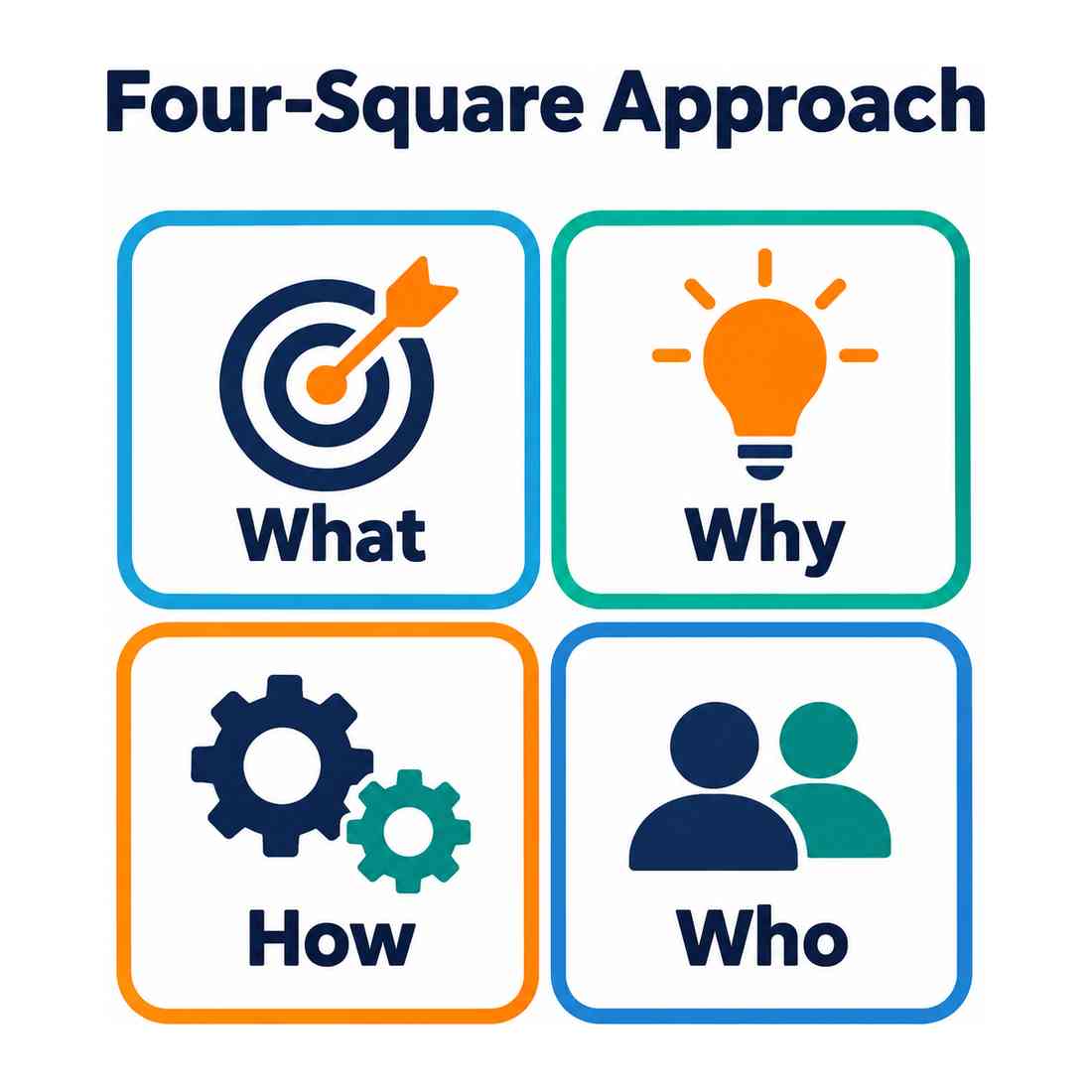
Leaders using Four-Square preparation can reach people with different communication preferences in the same conversation. The approach covers four concerns: What, Why, How, and Who. Its aim is to anticipate what different people need from the information and prepare one message that works for all of them.
What: Substance and Clarity
Some audience members want the main point first, along with the facts and the decision they need to make. Short recommendations, relevant data, and clear outcomes help them connect with the substance.
Why: Elaboration and Context
Other audience members need to know why the information matters: how it connects to organizational goals, what possibilities it creates, and why the direction is worth pursuing. Vision, storytelling, purpose, and thought-provoking questions help them see the broader meaning.
How: Relevant Examples and Execution
Some listeners focus on the practical details: how it will work, what steps it requires, and what challenges to expect. Processes, examples, timelines, and implementation details show how the message translates into action.
Who: Real-World Application and Impact
Others want to know what it means for people. They ask who it affects, who benefits, and how the change will touch teams and customers. Real-world applications and opportunities for dialogue help people see where they fit in the outcome.
Bringing All Four Together
A conventional presentation of a new cross-functional approval process might focus on the revised workflow. By contrast, a prepared message answers all four concerns: a clear explanation of the change, why it matters to the organization, how the process will function, and who it affects. People may value different information depending on the decision or the situation.
Addressing each concern can also signal something about the messenger’s judgment. What can show you know the material, and Why can show you understand what the idea is for. How can show you know what it takes to carry the plan out, and Who can show you’re paying attention to the people affected.
The reverse also holds: when a leader rolls out a new approval process, listeners may read each gap as a reflection of the leader’s judgment. A buried main point suggests a weak grasp of the change. Skipping the urgent-request case implies no one considered exceptions. Missing steps raise doubts about follow-through, and leaving out affected teams signals a plan that overlooked them.
Check how you cover the four concerns:
- Your default: When you present a plan, which of the four concerns do you tend to skip?
- Your next room: In your next cross-functional meeting, how would you make sure you answer each of the four concerns?
Before the meeting, ask a few people: “What would help you most going into this meeting (the main point, the context, how it will work, or who it affects)?” Their answers replace guesswork with information, and acting on them shows you listened.
Knowing what the room needs is half the preparation. Knowing what you bring to it is the other half.
Know Your Strengths, Then Engage the Room
The most effective leaders tend to use their authentic strengths. They also know that different people bring different expectations, motivations, and perspectives into every conversation. Building trust across an organization isn’t about becoming a different person for every audience. It’s about knowing yourself well enough to engage the people in front of you so influence can follow.
Before your next important meeting or cross-functional conversation, ask yourself three questions.
- Command: Do I know my own home base? What are my go-to ways of communicating? How might other people read them? Where do I need to be more intentional?
- Change: Have I prepared for everyone in the room? Does my message cover the What, Why, How, and Who? Am I planning only what I want to say, or what different people need to hear?
- Confidence: Am I planning to engage people as well as inform them? What questions will get people talking? Where might people disagree? How will I know whether people understand and are on board?
One more question belongs in every conversation: “Credible to whom, and in what form?”
Watermark Learning partners with organizations to develop the communication, engagement, and influence capabilities leaders need to build trust and strengthen cross-functional collaboration.
As your work reaches more teams, which part of communicating across them would you most like to sharpen?
Discover how Watermark Learning’s leadership development programs can help you earn credibility with the audiences you work with.

Jay Pugh, PhD
Dr. Jay Pugh is an award-winning leader, author, and facilitator with over 18 years of teaching and training experience. Currently serving as Head of Leadership Growth at Educate 360, he leads a robust team of external and internal facilitators who specialize in developing leadership capabilities within medium and large-scale businesses. His team works directly with business professionals, helping them become more effective leaders in their daily operations.
Dr. Pugh holds a Ph.D. in Instructional Management and Leadership, and his academic contributions include two published articles and a dissertation focusing on various educational topics. His extensive experience and academic background have established him as a respected voice in leadership development and educational management.


 New Horizons
 Project Management Academy
 Velopi
 Six Sigma Online
 Watermark Learning