

 New Horizons
 Project Management Academy
 Six Sigma Online
 TCM Security
 TRACOM
 Velopi
 Watermark Learning
 Login
Login


Key Takeaways
- Leadership Is the Differentiator: Leaders who apply judgment and context alongside AI tools outperform those who don’t
- Roles Are Changing, Not Vanishing: People still determine how teams adapt, collaborate, and decide inside that change
- Human Oversight Determines AI Value: Outcomes depend on the people using, guiding, and verifying AI work
- Context Still Belongs to People: Stakeholder engagement, managing resistance, and relationship management are leadership capabilities AI can’t replicate
- Leadership Capability Matters More Now: Communication, discernment, adaptability, and decision-making are now stronger competitive advantages
A department head walks into a cross-functional meeting prepared. Their AI-generated summary is polished, organized, and supported by clean recommendations. On paper, everything looks ready.
Ten minutes into the discussion, the gaps become obvious.
Someone raises a concern that never appeared in the source material. Another person points out a political dynamic that will change how the recommendation is received. A third questions a timeline assumption that no longer reflects current realities.
The issue isn’t that the AI produced poorly written output. It’s that leadership decisions rarely succeed or fail based solely on information. They succeed because someone in the room understands the people, context, timing, relationships, and organizational dynamics surrounding the decision.
Organizations getting the most value from AI aren’t the ones with the most advanced tools. They’re the ones with leaders who know where AI helps, where it creates risk, and where human judgment remains irreplaceable.
What The Headlines About AI Are Missing
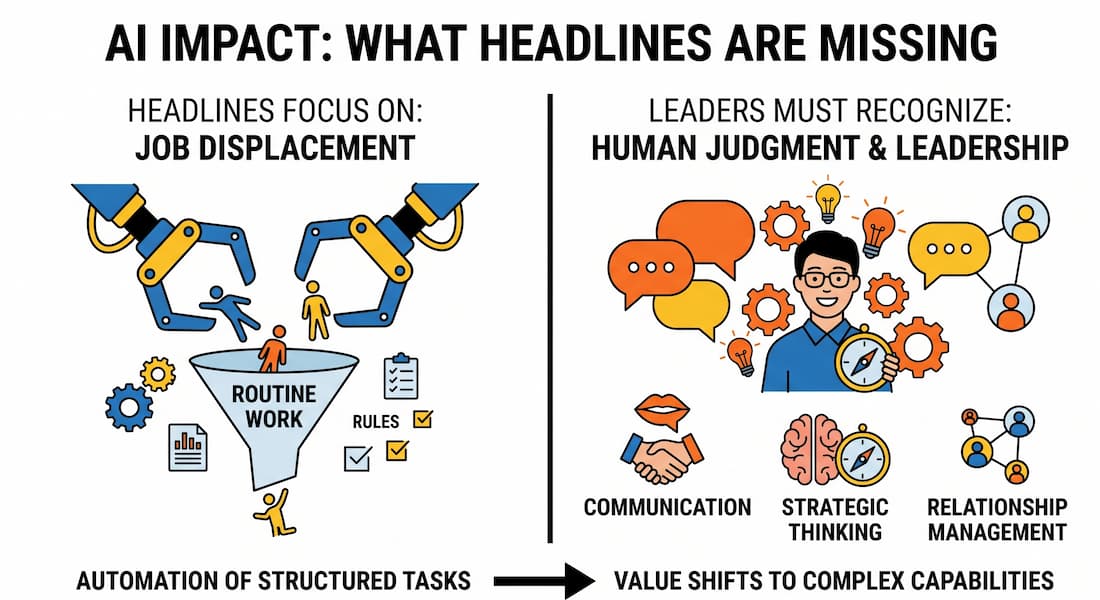
Many headlines about AI focus on job displacement, and the numbers are compelling. According to Challenger, Gray & Christmas, companies cited AI as the reason for 54,836 announced U.S. job cuts in 2025, representing roughly 4.5% of the year’s total planned cuts. But fixating on jobs eliminated misses the more important leadership challenge happening inside organizations, and work itself is changing.
Some tasks are becoming automated. Others are becoming more judgment-intensive. And as routine work decreases, the remaining work increasingly depends on communication, prioritization, discernment, collaboration, and decision-making.
The more AI absorbs structured tasks, the more valuable human leadership becomes.
Many organizations are still asking: “Which roles can AI replace?” The more useful question is this: “What human capabilities become more important once AI handles part of the work?” Three questions help leaders see this shift more clearly:
- What tasks are becoming easier to automate? These are often repetitive, rules-based, or highly structured
- What work remains once those tasks are removed? Usually work requiring prioritization, influence, interpretation, or judgment
- What human capabilities become more critical as routine work decreases? Often communication, adaptability, decision-making, and relationship management
The question of capabilities is only part of the picture. Roles themselves are changing. Business analysts, project managers, and data analysts won’t look the same in five years as they do today. The work that defined those roles is shifting toward critical evaluation, interdepartmental relationship management, and strategic thinking and acumen, and the leaders that are ahead of this shift will be better positioned to build teams that can handle what automation can’t.
Leaders who work through these questions make different decisions about hiring, development, and team structure, but recognizing this shift is only half the equation. The other half is understanding the conditions under which AI delivers value, and where it doesn’t.
AI Only Creates Value Under the Right Human Conditions
AI tools can improve speed, consistency, and efficiency in the right situations, but those outcomes aren’t automatic. Many organizations discover this after the fact, when a polished AI output leads to a decision that misses critical context, or when a team mistakes confident-sounding language for sound judgment.
The gap between what AI produces and what the situation requires is where leadership earns its value, and closing it depends on the judgment and skill of the people using the tools.
Three variables shape whether AI improves performance or creates new problems:
Type of Work
AI performs best when work is structured, repetitive, and pattern-based. As work becomes more strategic, relational, ambiguous, or emotionally complex, human judgment becomes increasingly important.
Deciding how to communicate a reorganization, navigate team resistance, or balance competing stakeholder priorities requires context and emotional awareness that can’t be automated.
User Capability
The quality of AI output often reflects the quality of the thinking behind it. Leaders who approach AI thoughtfully tend to get more useful results because they know how to frame questions, challenge assumptions, recognize weak outputs, and apply cross-functional alignment strategies to achieve broader organizational outcomes.
Teams relying on AI without strong critical thinking skills often mistake polished language for sound judgment.
Verification Discipline
AI output still requires human accountability. Without someone validating assumptions, checking accuracy, and applying subject matter expertise, mistakes spread quickly. Organizations that benefit most from AI aren’t the ones that remove people from the process. They’re the ones who strengthen how people guide and verify the process.
The real organizational risk is rarely the technology itself. It’s overconfidence, and the moment teams stop questioning the output, decision quality often starts to decline.
A team using AI to draft project updates may save hours each week while improving consistency. The same team using AI to determine whether a struggling initiative should be cut may receive an answer that sounds persuasive but lacks organizational history, stakeholder awareness, and political context.
The difference is the level of human judgment the work requires. Leaders who can identify where that judgment matters most and apply it consistently are the ones who get reliable value from AI.
Knowing When Human Judgment Matters Most
Many leaders already understand that AI can make mistakes, but the harder problem is subtler. AI often presents weak conclusions with the same confidence as strong ones, which means the risk isn’t always obvious until a decision has already been made. Recognizing that pattern early is a leadership skill, not a technology problem.
People still need to determine:
- whether the information is accurate
- whether the recommendation fits the situation
- whether important context is missing
- whether the output should influence a real decision at all
Experienced leaders who know whether to trust, challenge, or set aside AI output entirely hold a real competitive advantage.
AI output may sound confident regardless of complexity, but judgment still has to come from a person. The more complex the situation becomes, the more outcomes depend on human discernment.
A technically correct answer can still fail organizationally. This is especially true when the cost of a wrong decision extends beyond mere factual error, leading to damaged trust, reduced coordination, or poor execution.
Leaders who consistently perform well with AI treat its output as one input among several, keeping the judgment, context, and accountability that decision-making still requires. Those same leaders understand that the real test of their judgment isn’t in the documents AI produces. It shows up in conversations where organizational decisions are made.
Leadership’s Value Becomes More Visible in an AI Environment
AI can organize information, but it can’t interpret why someone suddenly disengaged, why a stakeholder went quiet, or why a team that verbally agrees still hesitates in execution. Those signals still require human awareness.
When AI reaches its limits, leadership steps in. People pay attention to how their leaders respond in those moments.
Leadership value becomes especially visible in three situations, and each one depends on human capabilities AI can’t replicate:
Reading the Room
Effective leaders recognize hesitation before it becomes resistance, and act on it before it becomes a problem. They notice changes in tone, participation, and engagement, creating space for concerns to surface early instead of forcing alignment that later breaks apart.
Interpersonal judgment allows leaders to adjust in real time, redirect a conversation before it derails, or draw out what others aren’t saying.
Managing Organizational Change
Reorganizations and strategic shifts succeed or fail based largely on trust and communication. Official messaging matters, but momentum often lives in side conversations and informal reactions, not in structured updates.
Leaders who can interpret those signals early are better positioned to maintain focus during uncertainty, adjust course before small problems compound, and keep teams moving when the path forward isn’t fully clear.
Building Agreement
Consensus is not the same as commitment. Effective leaders know how to build buy-in across competing perspectives, navigate political realities, and sustain trust through difficult decisions.
What separates effective leaders in those moments often comes down to preparation for key stakeholder engagement. Understanding the behavioral tendencies, personality preferences, and core values of the higher decision-makers in the room before the conversation starts changes the dynamic entirely. AI can help profile stakeholders, but the anticipation and preparation that agreement requires still belongs to the leader.
Building this kind of credibility develops over years of experience and relationship-building. AI can support parts of the process, but it can’t replace the human credibility needed to sustain outcomes.
As AI becomes more common, these leadership capabilities become more visible precisely because they aren’t easy to automate. The competitive advantage shifts away from access to information alone and toward the ability to apply judgment, influence, and contextual awareness where it has the greatest impact.
How to Develop the Leadership Capabilities That Matter Most
As AI changes how work gets done, leadership development priorities need to change with it. The organizations that adapt best aren’t simply training employees to use AI tools. They’re developing leaders who can combine AI fluency with strong human capability. Building those skills together is what separates high-performing teams from those that struggle to keep pace.
Three development areas stand out, and each one reinforces the others:
Leadership Capability
Communication, accountability, adaptability, influence, and interpersonal judgment remain foundational skills. These capabilities determine whether teams stay coordinated, motivated, and effective during periods of rapid change. As workflows become more automated, the human side of leadership becomes more important, not less.
Process Discipline
Prioritization, coordination, strategic thinking, and operational discipline turn ideas into outcomes. AI may speed up parts of the workflow. However, leaders still determine how work is organized, communicated, and sustained over time.
AI Fluency
Leaders don’t need to become technical experts, but AI fluency is becoming a leadership competency. Building working knowledge across five areas is where fluency starts:
- where AI adds value
- where it introduces risk
- how to verify outputs
- how to ask better questions
- when human oversight matters most
The goal is informed, deliberate application, not technical mastery.
These three capabilities strengthen each other. When they operate in isolation, gaps appear quickly. Communication without execution creates inconsistency, process discipline without interpersonal awareness leads to disengagement, and AI fluency without judgment creates risk.
Developing these capabilities together isn’t a one-time training event. It’s an ongoing investment in what determines whether AI becomes an advantage or a liability.
What This Shift Asks of Leaders
The conversation around AI still swings between extremes, from those who see it as an unstoppable replacement for human work to those who dismiss it entirely. Neither perspective helps leaders navigate what’s happening inside organizations. Both cause the same problem: leaders who aren’t developing the capabilities that the shift demands.
AI is becoming embedded in workflows, and it’s human capability that will separate high-performing organizations from struggling ones. Top-performing organizations have leaders who:
- apply judgment instead of relying on automation alone
- build trust and communicate clearly through uncertainty and change
- know when to challenge the output instead of accepting it
- develop teams that think critically instead of passively consuming information
These capabilities aren’t developed by deploying better technology. They’re developed by investing in the people who use them.
Technology accelerates work, but it’s people who determine whether it creates alignment, trust, momentum, and results. Organizations that invest in developing those capabilities now will be the ones setting the pace when others are still finding their footing.
Watermark Learning partners with organizations to help build the leadership capabilities AI can’t replicate: judgment, communication, adaptability, interpersonal awareness, and the ability to lead effectively through change.
As AI takes on more of the work, do your leaders have the skills to handle what’s left?
Discover how Watermark Learning’s leadership development programs can help your leaders build the capabilities AI can’t replace.

Jay Pugh, PhD
Dr. Jay Pugh is an award-winning leader, author, and facilitator with over 18 years of teaching and training experience. Currently serving as Head of Leadership Growth at Educate 360, he leads a robust team of external and internal facilitators who specialize in developing leadership capabilities within medium and large-scale businesses. His team works directly with business professionals, helping them become more effective leaders in their daily operations.
Dr. Pugh holds a Ph.D. in Instructional Management and Leadership, and his academic contributions include two published articles and a dissertation focusing on various educational topics. His extensive experience and academic background have established him as a respected voice in leadership development and educational management.


 New Horizons
 Project Management Academy
 Velopi
 Six Sigma Online
 Watermark Learning