

 New Horizons
 Project Management Academy
 Six Sigma Online
 TCM Security
 TRACOM
 Velopi
 Watermark Learning
 Login
Login


Key Takeaways
- Escalation Reveals Design: Frequent upward decisions signal unclear placement.
- Ownership Drives Flow: Named decision authority reduces hesitation and drift.
- Shared Method Matters: Consistent evaluation prevents circular debate.
- Boundaries Protect Focus: Clear escalation limits preserve leadership time.
- Scale Requires Discipline: Habitual reinforcement keeps decisions at the right level.
As organizations grow, decisions rise higher than they should. What once moved quickly within departments now requires leadership review, filling meetings with approvals, and slowing coordination. Leaders feel busy but not always focused on the right work.
At XentinelWave, senior leaders found themselves reviewing routine scheduling conflicts and budget tradeoffs between departments. These issues required judgment, but they didn’t shape broader priorities. Escalation had become a habit rather than a necessity. Leadership time narrowed as approval volume increased.
This pattern isn’t unique. Many organizations mistake involvement for control. The result is upward decision drift, where authority rises beyond its appropriate level and teams start waiting instead of deciding.
Scaling decisions requires more than delegation. It requires clarity about where decisions belong, how they’re made, and when they should rise to a leader with higher authority. When placement is intentional, leadership focus returns to guiding direction rather than resolving routine coordination.
When Decision Systems Break Down
Strong leaders step in because results matter. When work crosses departments, decisions often land on their desks. Over time, more issues move upward, even when broader direction isn’t required. The shift happens gradually as people grow used to sending coordination questions to higher levels.
This pattern shows up in consistent signals.
How Escalation Shows Up
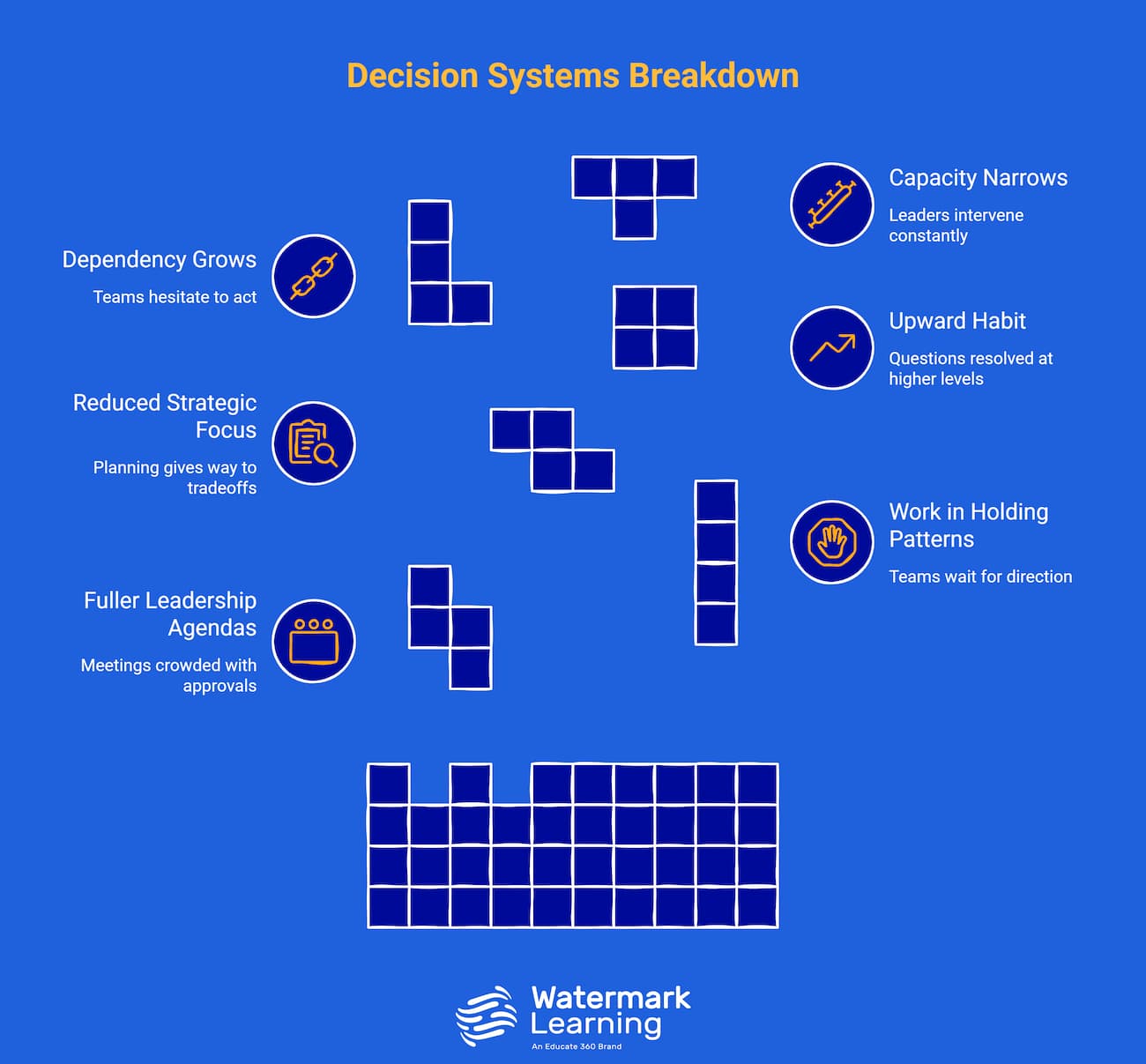
- Fuller Leadership Agendas: Weekly meetings are crowded with coordination approvals.
- Work in Holding Patterns: Teams wait for direction before moving ahead.
- Reduced Strategic Focus: Planning conversations give way to routine tradeoffs.
- Upward Habit: People escalate questions instead of resolving them together.
Each signal seems manageable on its own. Viewed together, they reveal authority concentrating at higher levels. Progress hinges on availability rather than clarity.
At XentinelWave, senior leaders reviewed scheduling conflicts and mid-cycle budget shifts between departments each week. These calls required judgment, but they didn’t shape long-term direction.
When leadership absorbs coordination work at this level, dependency grows. Teams hesitate. Leaders intervene. Capacity narrows. Proper authority alignment restores balance, but it only holds when leaders reinforce it consistently.
What It Takes to Keep Decisions at the Right Level
Scalable decision design ensures choices don’t depend on a single leader’s availability. Authority aligns with responsibility, and people know where decisions belong before pressure rises. Instead of sending issues upward by default, leaders understand who should make the call. Clarity replaces hesitation with action.
Three elements keep decisions from drifting upward.
What Holds Decision Discipline Together
- Clarity: Everyone knows who holds final decision ownership.
- Structure: Teams follow a shared method when evaluating options.
- Capability: Leaders reinforce sound judgment at every level.
If one element weakens, decisions begin drifting upward again. Clear ownership without structure creates inconsistency, while structure without capable leadership becomes rigid. And when capability exists without clarity, escalation returns.
This design doesn’t require complex systems. It requires disciplined placement reinforced through shared expectations. With these elements in place, leaders can more effectively separate different types of decisions and determine where authority should sit.
Separating Execution, Coordination, and Direction
Decisions differ in their impact and the authority required. Confusion grows when execution, coordination, and direction decisions are treated as if they require identical oversight. When distinctions aren’t clear, more decisions expand beyond their proper level. Separating decision types reinforces discipline in ownership.
Leaders can reduce confusion by recognizing three distinct categories.
Execution Coordination and Direction
- Execution Decisions: Frequent, day-to-day choices made within a team’s scope of work.
- Coordination Decisions: Cross-department tradeoffs involving shared resources, timing, or priorities.
- Direction Decisions: Choices that shape long-term focus, priorities, and overall risk.
When these categories blur, coordination decisions often rise because managers aren’t certain where their authority begins and ends. Cross-team tradeoffs stall while department leaders wait for guidance. Over time, senior leaders who should focus on direction get pulled into operational detail.
Clear classification makes placement intentional. Once leaders separate execution, coordination, and direction decisions, they can determine where ownership should sit. With decision types defined, ownership becomes the next question.
Clarifying Decision Ownership Across Departments
Classification clarifies the kind of decision, but ownership determines who makes it. When ownership isn’t clear, hesitation spreads across departments. Even capable leaders pause when it’s unclear who holds final authority.
Cross-department decisions stabilize when leaders define four distinct roles.
Who Owns the Decision
- Decision owner: Holds final responsibility for the call.
- Contributors: Provide input before the decision is made.
- Executors: Carry out the decision.
- Informed stakeholders: Receive communication afterward.
Each role serves a different purpose, and confusion begins when they overlap. When multiple contributors believe they share final authority, conversations last longer than necessary. Without a clearly named decision owner, escalation fills the gap.
At XentinelWave, overlapping authority between operations and finance pushed routine budget adjustments to senior review. No one lacked capability. Final ownership wasn’t defined.
Disciplined decision placement requires a guiding principle. Decisions should sit at the lowest level where authority is clearly defined and move upward only when impact extends beyond it. This balance protects outcomes while preserving speed. When ownership is defined, leaders can reinforce a shared approach to decision-making.
Establishing a Shared Decision Structure
Clear ownership improves placement, but consistency still depends on how leaders think through complex issues. Without a common structure, similar issues can produce different outcomes across departments. Creating a shared method keeps decisions grounded in the same logic.
Leaders at any level can use this structure across teams.
A Shared Way to Make Tradeoffs
- Define the Goal: Clarify the outcome the decision is meant to achieve.
- Identify Constraints: Clarify the limits on timing, budget, scope, or policy.
- Compare Options: Evaluate realistic alternatives instead of debating a single proposal.
- Assess Impact: Consider how the decision affects other teams or priorities.
- Record the Rationale: Capture why the decision was made for future reference.
This method doesn’t require complex tools or long meetings. It provides a consistent way to evaluate tradeoffs and explain the reasoning behind the outcome. When leaders follow the same structure, discussions become focused, and outcomes are more consistent.
A shared method alone doesn’t prevent unnecessary escalation. Leaders also need clarity on when decisions should be passed up to higher leaders and when they should remain in place. Defining those boundaries preserves control while protecting speed.
Defining Escalation Boundaries Across Departments
Escalation isn’t the problem. Some decisions need to move up because their impact extends beyond a single department. A department manager may escalate a scheduling conflict when authority limits aren’t clear. The issue begins when escalation happens by default rather than by design. Without clear boundaries, leaders step in more often than necessary.
Escalation tends to increase under a few predictable conditions.
Why Decisions Rise by Default
- Unclear Authority Limits: Decision rights aren’t clearly defined at each leadership level.
- No Shared Impact Criteria: Leaders lack agreement on which decisions require broader involvement.
- Inconsistent Decision Approach: Tradeoffs are evaluated differently across leaders.
When these conditions exist, escalation becomes a safety mechanism. Leaders move decisions upward to avoid overstepping authority or carrying risk alone. Over time, expectations shift, and escalation starts to feel routine.
Reducing escalation doesn’t mean removing oversight. It means defining clear triggers for when decisions should escalate and when they should remain in place. Once boundaries are reinforced, leaders spend less time reviewing routine matters and more time setting direction.
However, progress often unravels not because the structure fails, but because leaders gradually return to the behaviors that created the problem in the first place.
Preventing Slippage in Decision Discipline
Even with clear roles, shared methods, and defined boundaries, decision scaling can deteriorate. The breakdown rarely comes from resistance. More often, it stems from small behavioral shifts that reintroduce escalation. Leaders may not recognize the pattern until authority begins drifting upward once more.
Progress usually unravels through a few predictable mistakes.
How Decision Discipline Breaks Down
- Redefining Authority Midstream: Ownership shifts after decisions have already been assigned.
- Overriding Without Clear Criteria: Senior leaders step in without defined triggers.
- Inconsistent Reinforcement: Expectations change during urgency.
- Avoiding Direct Resolution: Leaders escalate cross-team tensions rather than resolving them.
These mistakes can seem reasonable in the moment. They may even feel like the responsible thing to do. Over time, however, they re-blur boundaries, rebuild dependency, and make escalation feel more appropriate.
Preventing these mistakes requires more than awareness; it requires a practical path leaders can follow.
Building Sustainable Decision Discipline
Creating lasting discipline in how decisions are made requires more than isolated adjustments. Leaders need to address structure, placement, and behavior in a deliberate sequence. When those elements are handled together, upward drift slows and authority stabilizes.
The following six-step process strengthens consistent decision practice across departments.
The Steps That Restore Decision Flow
- Identify Bottlenecks: Pinpoint where decisions slow or consistently escalate.
- Classify Decisions: Separate execution, coordination, and direction decisions to clarify placement.
- Clarify Ownership: Name the decision owner and define supporting roles.
- Introduce Shared Decision Steps: Apply a consistent method for evaluating tradeoffs.
- Define Escalation Limits: Establish clear triggers for when decisions should move up the chain.
- Reinforce Through Leadership Behavior: Model and protect clear decision placement.
This sequence moves from identification to clarity to reinforcement. It begins by recognizing where decisions slow or escalate, clarifies where authority belongs, and strengthens the behaviors that protect it. Each step builds on the last.
When leaders apply this path consistently, decisions stop escalating by default. Authority becomes clearer, coordination improves, and leadership time shifts back toward guiding priorities rather than reviewing routine tradeoffs. This shift allows decision design to operate independently of any single leader.
Designing Decision Flow for Scalable Growth
When decisions rise unnecessarily, leadership focus shifts away from long-term priorities. Approvals crowd out strategic priorities and slow organizational momentum. This pattern narrows leadership capacity and redirects attention from long-term direction to short-term coordination.
Scalable decision design brings clarity and stability. When leaders classify choices, define ownership, apply shared methods, and protect escalation boundaries, authority aligns with the appropriate level of responsibility. Leaders regain time to shape priorities rather than reviewing routine tradeoffs.
At Watermark Learning, we work with leaders at every level to build this discipline into how decisions move across departments. Decision scaling isn’t about giving up control. It’s about designing controls so they function at every level.
If your leaders are spending more time reviewing decisions than shaping direction, it may be time to rethink how decisions move across the organization.
Recommended Training:
- Making the Right Decisions Under Pressure
- Evolving into the Manager Role
- Critical Facilitation Skills for Leaders

Jay Pugh, PhD
Dr. Jay Pugh is an award-winning leader, author, and facilitator with over 18 years of teaching and training experience. Currently serving as Head of Leadership Growth at Educate 360, he leads a robust team of external and internal facilitators who specialize in developing leadership capabilities within medium and large-scale businesses. His team works directly with business professionals, helping them become more effective leaders in their daily operations.
Dr. Pugh holds a Ph.D. in Instructional Management and Leadership, and his academic contributions include two published articles and a dissertation focusing on various educational topics. His extensive experience and academic background have established him as a respected voice in leadership development and educational management.


 New Horizons
 Project Management Academy
 Velopi
 Six Sigma Online
 Watermark Learning