

 New Horizons
 Project Management Academy
 Six Sigma Online
 TCM Security
 TRACOM
 Velopi
 Watermark Learning
 Login
Login


Key Takeaways
- Ambiguity Signals Growth: Unclear needs reflect evolving cross-team understanding
- Diagnosis Before Action: Structured interpretation prevents wasted multi-team effort
- Reaction Builds Clarity: Shared models accelerate alignment across departments
- Premature Certainty Creates Risk: Early agreement hides gaps across teams
- Leadership Shapes Alignment: Strong facilitation supports consistent execution
When Teams Struggle to Define What They Need
Few challenges test a business analyst more than hearing, “We’re not sure what we want yet.” When that uncertainty spans several departments, progress stalls across the organization. Teams stay busy, yet they don’t move in the same direction.
Many organizations treat ambiguity as resistance or poor preparation. In reality, it often signals that a shared understanding hasn’t formed. When sales, operations, finance, and IT view the same issue differently, clarity doesn’t appear on demand.
At XentinelWave, a multi-department initiative began with a request for better reporting. Sales wanted faster visibility into pipeline performance, while finance questioned the accuracy of revenue projections. Decision cycles slowed as each group relied on different definitions and data sources. The issue was not effort. It was misaligned interpretation.
Managing ambiguity at this level requires more than extracting requirements. When several departments interpret the same problem differently, progress slows. Clarity forms through deliberate movement, not urgency. Understanding how that movement works changes how cross-functional initiatives succeed.
How Alignment Gradually Takes Shape Across Teams
When several departments share one initiative, uncertainty spreads quickly. More meetings rarely solve the problem. Progress requires a steady path that teams can follow together. Without structure, confusion expands instead of narrowing.
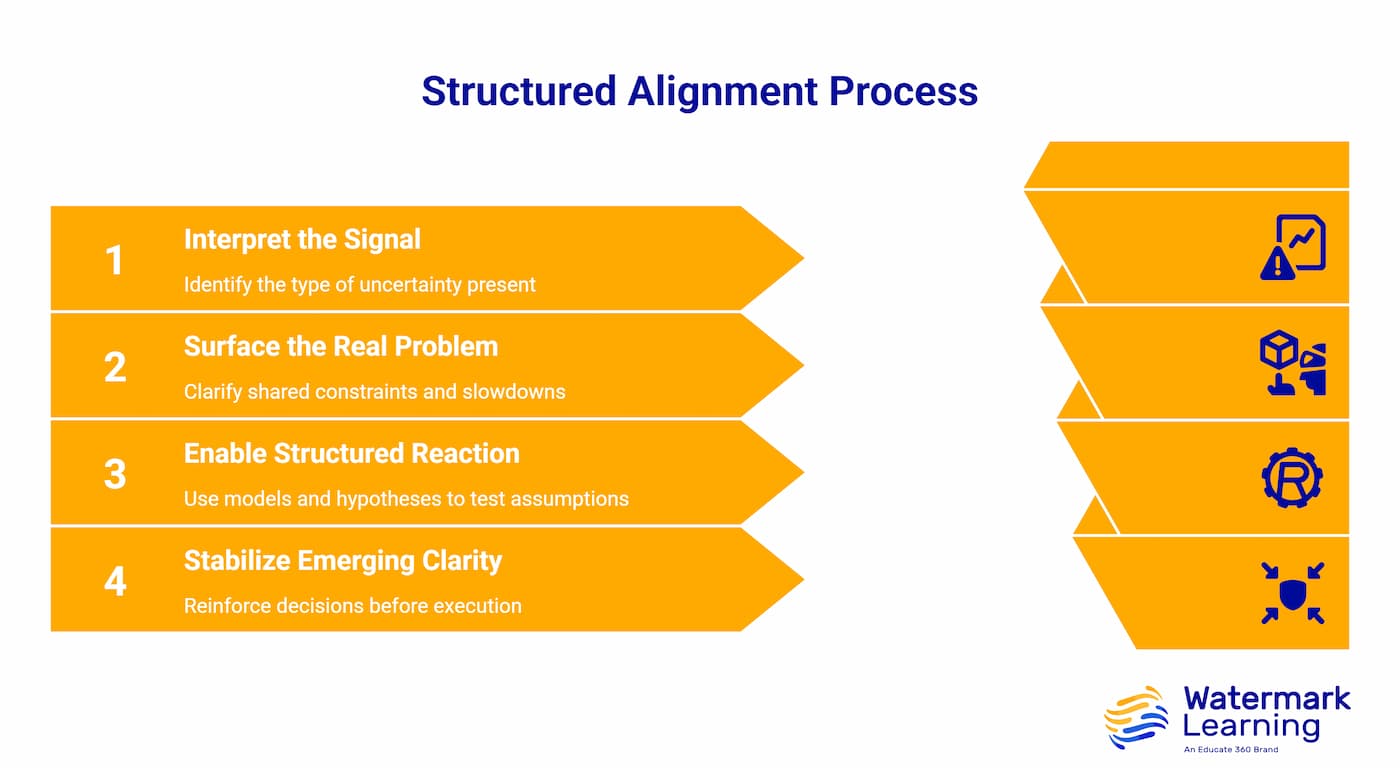
Clarity rarely emerges all at once in multi-department work. It’s built through deliberate steps taken in sequence. Cross-team alignment develops through a clear progression that teams can follow together.
Four Stages of Structured Alignment
- Interpret the Signal: Identify the type of uncertainty present before proposing solutions
- Surface the Real Problem: Clarify shared constraints and cross-team slowdowns
- Enable Structured Reaction: Use models and hypotheses to test assumptions
- Stabilize Emerging Clarity: Reinforce decisions before execution begins
This progression prevents rushed conclusions. Each stage strengthens understanding before investment decisions move forward.
A defined progression gives uncertainty boundaries. Teams stop circling the problem and begin moving through it intentionally. Momentum builds because people understand how clarity will develop, not just that it should. Once the path is steady, attention can turn to what the uncertainty is revealing.
What Unclear Requirements May Be Signaling
Ambiguity often feels like a barrier, yet it carries useful information. Across departments, unclear requirements usually reveal competing assumptions rather than weak effort. Before solutions enter the discussion, a business analyst must identify the type of uncertainty present.
Patterns begin to emerge once uncertainty is examined closely. In multi-department initiatives, unclear requirements typically cluster around specific alignment gaps. Those gaps tend to fall into recognizable categories.
Common Sources of Cross-Team Uncertainty
- Untranslated Strategy: Direction exists but lacks operational clarity
- Inconsistent Processes: Teams follow different steps for similar work
- Conflicting Success Measures: Departments define outcomes differently
- Unclear Ownership: Decision authority remains undefined
- Limited System Understanding: Capabilities are assumed rather than confirmed
Recognizing the source guides effective intervention. Without a diagnosis, teams risk solving the wrong problem together.
At XentinelWave, the reporting request first appeared technical. Early discussions exposed inconsistent data definitions across departments. The ambiguity pointed to organizational misalignment rather than missing software features.
Clarity emerges once the source of uncertainty is understood. Conversations shift from reacting to symptoms toward examining alignment gaps. Energy concentrates instead of scattering across departments. How uncertainty presents often reflects the organization’s level of maturity, which shapes how alignment challenges emerge.
How Organizational Growth Influences Clarity
Organizational growth reshapes how clarity forms. What feels manageable in a small team can become coordination strain in a larger enterprise. As roles expand and departments specialize, shared interpretation becomes harder to sustain. Recognizing this shift helps business analysts and cross-team leaders diagnose uncertainty more precisely.
Growth introduces structural complexity. Departments develop distinct processes, metrics, and priorities. Shared interpretation now requires more effort than in earlier stages. Without deliberate alignment, small misunderstandings expand into cross-team uncertainty.
These growth stages tend to produce predictable forms of cross-team uncertainty.
Patterns of Uncertainty by Growth Stage
- Early-Stage Organizations: Direction evolves quickly, and processes remain informal across teams.
- Mid-Sized Organizations: Processes formalize, yet departments interpret standards in different ways.
- Large Enterprises: Layered governance, multiple reporting lines, and competing metrics complicate agreement.
Each stage introduces distinct cross-department challenges. In younger firms, uncertainty often reflects exploration. In mid-sized environments, it reflects inconsistency. In large enterprises, it reflects structural complexity. Recognizing the maturity context sharpens diagnosis and clarifies where investigation must begin.
Bringing the Real Cross-Team Issue into Clearer Focus
Recurring slowdowns often point to the real issue beneath unclear requirements. While teams may struggle to agree on definitions, decision boundaries, or process steps, they can usually describe where work stalls or handoffs break down. Those breakdown points expose shared constraints across departments. Once those constraints become visible, alignment can begin.
Pushing harder for detailed requirements rarely resolves cross-team uncertainty. Progress improves when attention shifts toward observable breakdowns in workflow and decision-making. Focused questions help bring those gaps into view.
Questions That Expose Root Issues
- Where Does Work Slow: Identify recurring delays between teams
- Which Decisions Create Debate: Identify points of disagreement
- What Data Creates Conflict: Clarify inconsistent definitions or metrics
- Where Do Handoffs Break Down: Expose gaps between responsibilities
These questions shift the conversation from vague requests toward shared operational constraints.
At XentinelWave, deeper questioning revealed inconsistent approval definitions layered on top of conflicting performance data. Each department believed its process worked. Outcomes told a different story.
Shared visibility reshapes how departments engage with one another. Once constraints are clear, conversations shift from defending positions to examining evidence. Alignment strengthens as teams react to the same reality. At that point, team behavior begins shaping what happens next.
How Teams Tend to React When Clarity Is Limited
Unclear requirements create predictable team reactions. When direction feels uncertain, departments look for stability in familiar definitions and established practices, protecting what they understand. These responses are natural, yet they shape how cross-department alignment develops.
Pressure makes these patterns more visible. Teams may prioritize comfort over careful analysis. Recognizing these tendencies allows facilitators to guide discussion deliberately rather than impulsively.
Common Human Reactions to Ambiguity
- Solution Jumping: Stakeholders propose fixes before the root issue is defined
- Protecting Existing Definitions: Departments defend existing terminology and processes
- Unspoken Disagreement: Teams appear aligned while concerns remain unaddressed
- Avoiding Conflict: Silence replaces clarification to preserve short-term harmony
These reactions rarely reflect resistance. They signal discomfort with uncertainty and exposure. Left unexamined, they accelerate premature agreement and weaken long-term alignment. When leaders address these behaviors directly, discussions become clearer and decisions grow stronger.
Creating More Productive Dialogue Around Unclear Needs
Clarity strengthens when teams respond to something concrete. In cross-functional work, open discussion without structure often leads to circular debate. Shared visuals and testable ideas focus attention and ground the conversation, allowing evidence to replace opinion.
As dialogue shifts toward visible models, conversations become more disciplined. Teams move from defending positions to refining shared artifacts. The right tools help maintain this focus and keep cross-department discussion grounded.
Ways to Create a Structured Reaction
- Working Hypotheses: Offer a testable statement that teams can confirm or revise
- Process Maps: Make handoffs and gaps visible across departments
- Decision Flows: Show how choices move between roles and groups
- Simple Wireframes: Make assumptions about screens, inputs, and ownership visible
These tools anchor discussion in observable detail. Each refinement strengthens shared understanding before execution begins.
At XentinelWave, a cross-functional workflow diagram exposed three different interpretations of final approval. Seeing the process mapped clearly shifted the conversation. Misalignment became visible and correctable.
Repeated testing and revision reduce uncertainty over time. Each cycle builds confidence because teams respond to shared evidence rather than assumptions. As understanding stabilizes, alignment becomes more durable and less fragile under pressure.
Strengthening Alignment Before Execution Accelerates
Early agreement can feel reassuring under deadline pressure. Teams may share language while holding different interpretations. Before decisions move forward, emerging clarity needs reinforcement. Deliberate timing protects execution from unseen gaps.
Pressure to demonstrate progress often pushes teams toward quick consensus. Alignment that forms too quickly can conceal unresolved differences. The risks become visible as work begins.
Risks of Premature Agreement
- Misdefined Problems: Teams commit to solving the wrong issue
- Hidden Disagreement: Apparent consensus masks unresolved concerns
- False Confidence: Leaders assume alignment without verification
- Late Rework: Corrections emerge during execution
Rushed agreement increases downstream costs and strain across departments as hidden differences surface during execution.
As alignment deepens, disagreement may become more visible. Multi-department initiatives require open discussion of competing priorities. Skilled facilitation keeps that tension productive rather than divisive.
Shared meaning holds only when reinforced deliberately. Documented decisions, defined ownership, and visible assumptions reduce drift under pressure. Execution stabilizes when hopeful agreement gives way to verified understanding.
When Unclear Requirements Begin to Affect Execution
Ignored ambiguity or rushed decisions rarely leave projects stable. Early assumptions travel forward unchecked, especially in multi-department initiatives where interpretation varies. Teams may appear aligned at first, yet small differences compound as work advances. Execution eventually exposes gaps that earlier conversations failed to resolve.
When early assumptions go untested, recognizable consequences begin to surface. Rework increases, trust erodes, and confidence declines across departments.
Common Consequences of Ignored Uncertainty
- Late-Stage Rework: Corrections ripple across departments
- Strained Relationships: Trust erodes between teams
- Declining Confidence: Leaders question earlier decisions
- Rising Costs: Budgets increase due to avoidable revisions
Most failed initiatives begin with premature certainty, not poor intent.
Ambiguity rarely derails a project in a single moment. It weakens alignment gradually through small breakdowns that compound over time. Recognizing these warning signs creates the opportunity to restore shared understanding before execution accelerates further. When clarity begins to take hold, its effects become measurable.
Recognizing When Cross-Team Alignment Is Taking Hold
Clarity becomes visible in how teams operate together. In multi-department work, real alignment shows up through consistent behavior, not confident language. Conversations shift, decisions stabilize, and handoffs require less correction.
As alignment stabilizes, its impact becomes easier for business analysts and cross-team leaders to measure. Certain indicators begin to appear consistently across multi-department initiatives.
Observable Signs of Cross-Team Alignment
- Faster Decision Cycles: Debates shorten because shared definitions already exist
- Stable Documentation: Requirements stop shifting in small increments
- Consistent Terminology: Teams use the same language across departments
- Reduced Rework: Fewer corrections surface late in execution
- Improved Handoffs: Workflow moves smoothly between teams without repeated clarification.
These signals reflect shared understanding rather than surface agreement. When they appear together, alignment has moved beyond discussion into consistent practice. Execution stabilizes when teams operate from shared assumptions. Maintaining that stability depends on the capabilities of those guiding the work.
The Leadership Capabilities That Sustain Alignment
Stakeholders who admit uncertainty often surface real complexity. In multi-department work, each group brings distinct risks and definitions of success. Shared understanding develops through steady guidance, not pressure. Strong facilitation turns unclear needs into stable decisions.
When cross-team initiatives stall, the issue often reflects leadership discipline rather than effort or tools. Teams need business analysts and cross-team leaders who can guide uncertainty without rushing toward fragile agreement. This capability develops through training, deliberate practice, and disciplined reflection.
Watermark Learning equips leaders and business analysts with practical skills to facilitate complex conversations, clarify competing definitions, and stabilize alignment before execution begins. Strong leadership turns uncertainty into a disciplined phase of progress.
Organizations operating across departments can’t rely on informal alignment. Strengthen the leadership capabilities that hold cross-team execution together. Build the skills that convert unclear requirements into coordinated action.
Recommended Training:
- Critical Facilitation Skills for Leaders
- Business Analysis Foundations
- Making the Right Decisions Under Pressure

Jay Pugh, PhD
Dr. Jay Pugh is an award-winning leader, author, and facilitator with over 18 years of teaching and training experience. Currently serving as Head of Leadership Growth at Educate 360, he leads a robust team of external and internal facilitators who specialize in developing leadership capabilities within medium and large-scale businesses. His team works directly with business professionals, helping them become more effective leaders in their daily operations.
Dr. Pugh holds a Ph.D. in Instructional Management and Leadership, and his academic contributions include two published articles and a dissertation focusing on various educational topics. His extensive experience and academic background have established him as a respected voice in leadership development and educational management.


 New Horizons
 Project Management Academy
 Velopi
 Six Sigma Online
 Watermark Learning