

 New Horizons
 Project Management Academy
 Six Sigma Online
 TCM Security
 TRACOM
 Velopi
 Watermark Learning
 Login
Login


Key Takeaways
- The Diagnosis Is Backward: Job design, not attitude, drives declined promotions and existing manager burnout
- Nobody Audited the Job: Roles absorb years of additions that never get revisited or removed
- Strip Before You Add: Redesign starts with removing outdated work, not adding perks
- Authority Has to Come Back: People decline roles where they’re accountable for results they don’t control
- The Pitch Has to Change Too: Even with a role redesign, you can’t expect a different outcome when the pitch doesn’t change
Marcus had watched Elena carry the team through the last product launch, catching problems before they became fires and mentoring two new hires without being asked. At twenty-six, she was exactly whom he wanted to promote. So when the manager role opened, he assumed she’d jump at it. She turned it down. Politely, but firmly, for the second time in eighteen months.
His first instinct was to make a generational assumption. Gen Z doesn’t want to lead, he told himself. That instinct is common, and it’s backed by real numbers: research from Robert Walters found that 52% of workers under 30 are reluctant to move into middle management.
The more useful question is what she looked at when she said no, and whether the job itself gave her a reason to say yes.
Generational attitude plays some role, but underneath compensation concerns and burnout sits a structural problem.
The manager position itself was never redesigned as the work around it changed. As responsibilities accumulate while authority remains fixed, burnout and compensation dissatisfaction become symptoms of the same problem. The same structural problem sits underneath managers already in the role, not just those deciding whether to accept it. What matters most is whether the job in front of someone still makes sense to take.
Why “Nobody Wants to Lead” Is the Wrong Diagnosis
“Conscious unbossing” is the term that has come to describe what Elena did. It describes professionals who look at the traditional path into management and decide against it, with full awareness of what they’re turning down. The common response treats it as a mindset problem, something to correct with a better pitch about career growth and impact.
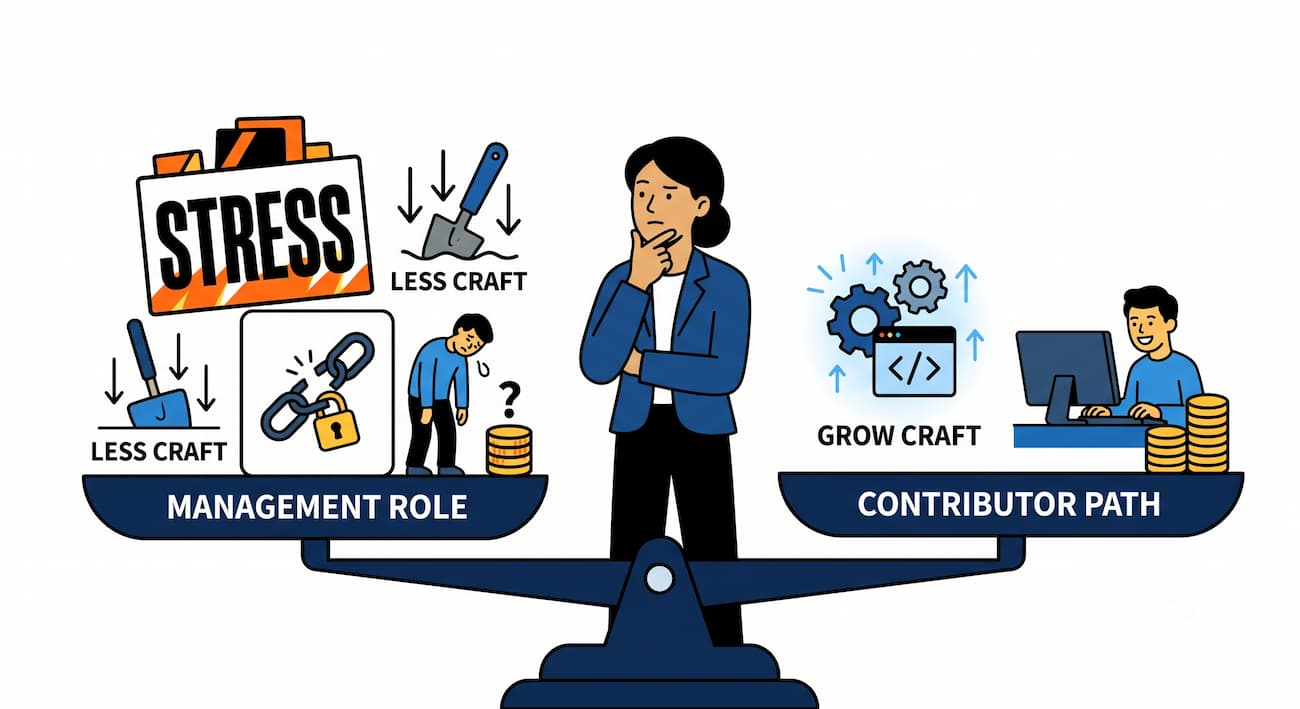
Elena made an accurate read of the opportunity. She watched three people accept the role and saw what it cost each of them.
Common patterns stood out:
- Reduced technical work: Each one spent less time on the craft work that made them a strong candidate
- Unmatched authority: Each one carried accountability for outcomes they had little real say in shaping
- Flat compensation gap: Each one saw a pay bump that didn’t cover the added hours and stress
- Eroding morale: Each one grew visibly more worn down the longer they held the role
The role first-line managers are being asked to fill has changed substantially over the past decade, and organizations sometimes leave the expectations attached to it unchanged.
What they’re rejecting is a specific version of leadership, one that has absorbed years of accumulated expectations without shedding what became obsolete along the way.
Responsibilities arrive one at a time, from different departments. No single person understands the whole picture. Each addition looks small to whoever’s making it, one more form, one more meeting. But small additions still land on top of everything else already accumulated, making each one a bigger ask than assumed. In many organizations, no one thinks to learn what the role entails.
The Job’s Hidden Scope Creep
Learning what a role entails starts with understanding how it grew. Managerial scope creep rarely results from one deliberate decision. Legal flags a risk and adds a new compliance requirement. Leadership wants better visibility and adds a dashboard. Two departments need better coordination, so they add a meeting. For the manager, each one becomes an added responsibility.
All the pieces obscure the whole picture. What’s left is something no one designed on purpose.
- Digital reporting layers: New dashboards add visibility for leadership, and managers maintain them
- Compliance and documentation: New forms and sign-offs from regulatory and HR changes fall to managers
- Meeting load: Flatter org structures pull managers into more cross-functional meetings to fill the gap
- Leftover technical work: Old individual-contributor duties stay with managers, with no budget for backfilling
Additions have sponsors. Legal, IT, HR, whoever needed the new process to exist, someone can always explain why it’s there. Removals don’t. The department that added a requirement is often the one still defending it, or has moved on and stopped thinking about it at all. No one pushes back, so nothing gets removed.
Gallup’s research found that global manager engagement fell from 30% to 27% in a single year, the steepest decline of any worker category Gallup tracks. A role absorbing work with no corresponding subtraction wears people down at a measurable rate.
Several clues show a manager role has outgrown its original design: reporting into more than one system tracking the same metrics, sitting through a weekly meeting that rarely produces a decision, or working on individual-contributor duties no one expected them to keep doing.
Each clue points to a fix. Consolidate overlapping reporting into one system. Audit the recurring meeting list and cut anything that isn’t producing decisions. Remove the individual-contributor duties that no longer belong to the role. Making these changes takes time and an honest evaluation of what the job has become.
Strip Out What Doesn’t Belong
Deciding what to remove is what separates a real redesign from a cosmetic one. Most redesign efforts skip this step and move straight to adding support, more pay, better titles, extra recognition, without ever asking whether the underlying job still makes sense to keep as built.
Removal must come first. A role with too much in it doesn’t get fixed by adding perks.
Three categories are easy to remove: the reporting layers, compliance paperwork, and meeting load already covered. A fourth, often overlooked category is leftover technical work, since it doesn’t look like scope creep. The manager staying hands-on reads as dedication rather than a problem.
Removing this work doesn’t mean it disappears. Automation and consolidation shift status reporting into a single system. Low-level coordination shifts to a team lead or a shared calendar. Simplifying processes eliminates administrative overhead, or the work moves to a role built for it.
Organizations tend to protect work that’s easy to measure: reports, approvals, dashboards, even when it contributes less to leadership effectiveness than coaching or judgment. Over time, measurable work crowds out meaningful leadership work. Cutting all four categories frees up the hours a manager needs.
Managers use that freed-up time to lead their teams. It goes toward coaching a struggling team member, catching a process issue early, or being present to notice when someone on the team is disengaged.
Capacity isn’t the whole fix, though. Whether the role feels worth taking also depends on authority, a separate problem that capacity alone doesn’t solve.
Give the Role Real Authority
The role hands out accountability faster than it hands out authority. They’re held accountable for turnover, output, and morale, while decisions about staffing, budget, and process sit two levels above them. A gap between responsibility and authority makes the role feel hollow, even when the hours are manageable. A manager blamed for turnover but denied the authority to adjust a schedule feels that gap directly.
Giving managers appropriate authority means something specific, rather than a vague promise of “more say.”
A few changes matter most:
- Decision-making authority: Making staffing, scheduling, and process calls without escalating
- Resourcing and support: Budget and tools to act on what the role requires
- Input into the role itself: A voice in how the job takes shape
- Clear escalation boundaries: A defined line between what’s owned outright and what needs sign-off
None of these changes are the same as a recognition program or a stipend. While those can be valuable, they don’t address the structural gap in authority. Compensation matters too, and a role with greater authority usually justifies higher pay. But pay should follow the redesign, not substitute for it. Extra compensation attached to the old role only makes it more expensive to keep.
Workflows, delegation, and promotion conversations within a single department are fair game, and redesigning them restores authority.
Match accountability to the decisions a manager can make, then give them influence over the outcomes they’re measured on. Do both, and the role stops needing a hard sell. It starts selling itself, provided the pitch describes what changed.
Redesigning the Promotion Conversation Itself
Pitching a redefined role replaces the old script, one written for a job that no longer exists. Persuasion became necessary because the job wasn’t worth taking on its own merits. People could sense that, and closing the gap took extra effort. A redesigned role only needs an honest pitch.
The old conversation and the new one sound different.
Before: “This is a big opportunity, more responsibility, more visibility with leadership, and it shows you’re ready for the next level.”
After: “Here’s what’s changed about this role: the reporting overhead is gone, you’ll have real authority over scheduling and staffing decisions, and we built this redesign with input from the last three people who turned it down.”
The difference is substance. One pitch sells potential. A redesigned pitch gives the candidate something to verify instead: specific tasks removed, specific decisions they’ll now own, specific input from the people who said no last time and explained why.
A candidate who has watched the old version of this role up close, as internal promotions often allow, is persuaded by evidence, not enthusiasm. A repackaged version of the old pitch won’t pass that test; only a genuine reframe will. The job, the pitch, and the person hearing it all need to line up before someone says yes.
This Was Never a Willingness Problem
The role, not the person, is what needs fixing, whether the person is Gen Z or anyone else being asked to say yes to it. A job built by accumulation, unmatched to its authority, and pitched from an old script will get turned down regardless of who’s asked to fill it.
This kind of problem is solvable, and it starts smaller than many leaders assume. Most of the ground to cover sits inside the authority one person already has. However, some organizational structures require more coordination than a single department can provide alone. The work begins with a single job description and the question: what are the duties of this role, and does the person doing it have the authority to match?
One department, one role, one honest look at what’s being asked and what’s being given in return. The result shows up fast. If the next promotion conversation still gets a no, the redesign doesn’t go far enough.
Watermark Learning’s leadership training reinforces the skills needed to succeed in a redesigned managerial role, where authority and responsibility match. Once the redesign is complete, training gives the person stepping into the role a way to grow into the authority and judgment it now requires.
Where does the manager role in your department stand right now: overloaded, underauthorized, or both?
Build the role first. Then build the leader who fills it.

Jay Pugh, PhD
Dr. Jay Pugh is an award-winning leader, author, and facilitator with over 18 years of teaching and training experience. Currently serving as Head of Leadership Growth at Educate 360, he leads a robust team of external and internal facilitators who specialize in developing leadership capabilities within medium and large-scale businesses. His team works directly with business professionals, helping them become more effective leaders in their daily operations.
Dr. Pugh holds a Ph.D. in Instructional Management and Leadership, and his academic contributions include two published articles and a dissertation focusing on various educational topics. His extensive experience and academic background have established him as a respected voice in leadership development and educational management.


 New Horizons
 Project Management Academy
 Velopi
 Six Sigma Online
 Watermark Learning