

 New Horizons
 Project Management Academy
 Six Sigma Online
 TCM Security
 TRACOM
 Velopi
 Watermark Learning
 Login
Login


Key Takeaways
- Assumed Processes Fail First: Automation breaks when the documented process doesn’t match reality
- Resistance Has Three Faces: Visibility, momentum, and capacity pressure all push organizations to move fast rather than map first
- Maps Need Decision Triggers: A good process map shows what must be resolved before automation can work
- Ownership Gaps Need Sponsors: Multi-departmental automation forces ownership decisions that organizations have avoided
- Reading the Room Is a Skill: When leadership proceeds anyway, the BA’s job shifts to documentation and recovery
Three weeks after launch, the AI automation initiative is already broken. The post-mortem has been circulating for two days, most of it relitigating the rollout schedule and vendor decisions. Near the bottom is the one finding that explains the failure. Everyone agreed on what the process looked like. Nobody had checked whether that version matched how it ran.
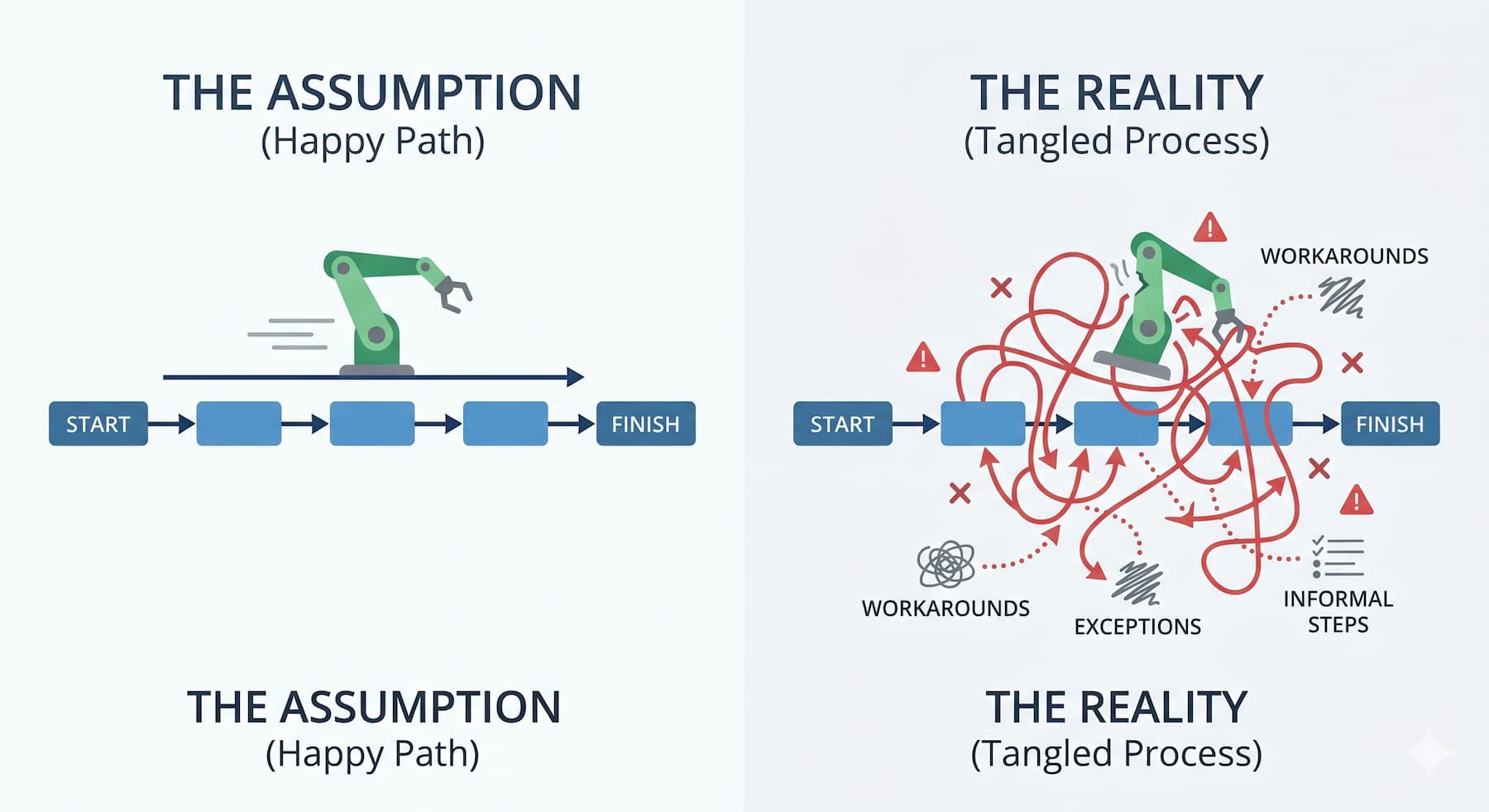
The organization moved forward because everyone believed the workflow was understood. What they had was the happy-path version. The process on a good day, with the right people, handling routine transactions. Three departments had spent six years building workarounds, informal approval steps, and exception-handling paths around it. None of that made it into the design conversation.
Multi-departmental automation amplifies this. Each team maintains its own workflow, and nobody has compared those versions side by side because, until now, the inconsistencies have been self-correcting. The automation removes that correction. What gets mapped before deployment determines whether the next initiative succeeds.
The Assumption That Broke the Automation
AI automation failures tend to cluster around a pattern that shows up across industries and initiative types. The gap between the process leadership believes exists and the one that operates is where most of them begin. Accountability shifts away from technology failure and toward organizational visibility.
In automation initiatives, the documented process tends to become the working assumption before anyone verifies it against how the work is done. Teams treat the happy-path version as the full picture and move forward.
Workarounds, informal judgment calls, and exception handling that keep the process running day to day often go unexamined during the design conversation when delivery speed is the priority and teams compress discovery to keep pace.
What gets built in a compressed window is the problem. There’s a difference between a process map that describes what a workflow is supposed to look like and one that determines what it would take to automate it reliably. One describes the workflow. The other determines whether it’s safe to automate.
Undocumented processes take several forms, each carrying a different category of automation risk:
- Informal exception routing: Transactions outside the standard workflow get resolved through personal judgment calls
- Compensating workarounds: Fixes built around broken upstream steps that disappear when automation replaces them
- Volume-dependent behavior: The process runs differently under increased workload than normal, and the difference hasn’t been mapped
- Assumed handoff agreements: Cross-team coordination built on verbal understandings that both sides remember differently
None of these appear in the happy-path diagram. All of them become design decisions the moment the automation goes live.
When a process spans multiple departments, the problem of assumptions compounds. KPI definitions drift. Escalation paths diverge. Exception handling that used to be a judgment call becomes a design decision the automation must encode. Knowing where those decisions are hiding is what separates a map that describes the process from one that protects the deployment.
Why the Push to Automate Works Against Process Mapping
Organizations skip mapping because the pressures running against it don’t arrive one at a time. They’re political and operational as much as financial, and each rewards momentum over visibility. The combination is harder to push back on than any single objection. Experienced BAs learn to read these pressures early and respond accordingly.
Visibility Pressure: Formal mapping puts problems on the record that teams never labeled as systemic. Managers resist because the accountability for those gaps lands on them.
Momentum Pressure: Executive sponsors, vendors, and procurement teams all have incentives tied to keeping the initiative moving. Mapping requests get reframed as implementation drag.
Capacity Pressure: The teams needed for discovery are already overloaded running the current operation. A BA who approaches discovery like a comprehensive audit creates drag the organization can’t absorb right now.
Together, they create an environment where the cost of slowing down feels more immediate than the cost of getting it wrong. BAs who know what to look for can read these signals before the window closes:
- Shrinking access: Stakeholder lists narrow after kickoff; the people closest to the real process stop being invited to discovery conversations
- Reframed timelines: Leadership recharacterizes mapping requests as scope creep instead of treating them as discovery gaps
- Premature solution language: Conversations shift to “how will the tool handle it” before the process is understood
- Escalation avoidance: Ownership questions get redirected to working teams instead of being answered where they need to be resolved
BAs who recognize these signals early get ahead of the risk. Those who miss them document it after the fact. The window is finite, and once the initiative gains enough momentum, discovery stops being a conversation about readiness and becomes one about delay. What gets mapped before that point determines what the automation is built on.
What a Process Map Needs to Get Right
Knowing the pressures exist is one thing. Knowing where to focus despite them is another. Building a reliable foundation doesn’t require mapping everything. It requires targeted visibility into the places where automation is most likely to fail. Precision matters more than coverage.
The highest-risk areas follow a consistent pattern. Handoffs are where work passes between teams, accountability becomes unclear, and operational shortcuts take root in the workflow. Risk lives within individual teams too, where escalation paths go undocumented, approval authority drifts, and critical workflow steps rely on knowledge only one person carries.
In practice, five operational patterns create the most automation risk time and again:
- KPI misalignment: The same transaction gets classified differently depending on which department you ask
- Hidden dependencies: The output of one team affects how another team’s work will run but the connection isn’t mapped
- Drifted approval authority: Who’s documented as the decision-maker and who makes the call don’t match
- Knowledge concentration: Specific individuals hold critical workflow knowledge that lives nowhere in the documentation
- Throughput cliff: Exception handling that worked at manual volume breaks under automation-scale load
Any one of these patterns can break an automation that tested cleanly and launched on schedule. Readiness means sufficient visibility into the highest-risk decision points and handoff boundaries to inform a deployment decision. Knowing which of these patterns apply to a specific workflow is what makes it actionable.
When the mapping exposes a specific gap, the ask becomes specific too. “We need visibility into the handoff boundaries and exception authority around this transaction type before this workflow is ready to automate” is a bounded ask leadership can act on. When the findings are that concrete, the conversation moves from the map to who is willing to own what it found.
Getting Leadership to Own the Mapping Findings
A credible mapping exercise does more than describe the process. It exposes decisions that working teams have been deferring because no single team owned them and no deadline forced the question. Automation creates that deadline. Before deployment, someone with authority needs to answer each of them.
Four questions need answers before deployment proceeds:
- Who owns process arbitration when departments disagree on exception handling?
- Who holds escalation authority when the automation encounters an unplanned case?
- Which policy ambiguities need leadership clarification before deployment?
- Which unresolved ownership gaps create risk if the automation proceeds unchanged?
Leadership tends to acknowledge these questions and move on without answering them. Formal accountability for a process that previously operated informally is uncomfortable, and without a direct connection to deployment risk, the questions get dropped.
Naming the failure costs precisely is what creates urgency and keeps the questions alive. “Resolving the escalation authority on exception type X reduces the cost of fixing this after deployment” is the kind of sentence that gets a decision made.
Experienced BAs recognize when leadership acknowledges the problem without committing to own it. The practical response: separate issues requiring executive ownership from those solvable at the working level, and escalate the latter to the level where accountability lives.
When unresolved ownership stays informal, the BA absorbs the coordination work that governance should be doing. The gap stops being visible to anyone with the authority to close it. At some point, leadership will make a call anyway. How well the BA has positioned the organization determines whether the recovery is manageable.
When Leadership Proceeds Anyway
Not every mapping conversation ends with a delay. Mapping is complete, risks are documented, leadership understands the exposure, and the organization proceeds anyway. It’s a governance reality that multi-departmental AI automation often produces, and the BA has to know what to do next.
Two situations require different approaches: one in which the decision is still movable, and one in which the organization has already committed. When there’s still room to influence the outcome, specific operational language is what moves the decision.
- “The vendor already has a framework.” The framework assumes consistent handoff behavior; the mapping already shows otherwise
- “We’ll optimize after phase one.” Post-launch optimization works for stable workflows; this one still has unresolved exception handling
- “The process varies too much to document.” Variation is exactly what needs to be visible before automating around it
- “We need quick wins first.” Scoping to the two highest-risk handoffs gets the visibility without slowing the rollout
Each of these responses anchors the conversation to operational specifics, where it has the best chance of changing the outcome.
Knowing which gaps to push on is just as important as knowing how. Escalate the ones where failure is traceable and recovery is high-cost. Document and monitor everything else. A BA who treats every finding as equally urgent quickly loses the room.
When an organization has already committed, the BA’s job shifts from influence to positioning. Document every risk you flagged, clarify ownership decisions in writing, and maintain relationships with the sponsor and recovery team. The BA’s job is to be the person the recovery team calls first.
What the Post-Mortem Says About the BA’s Judgment
Automation fails because the process that got deployed was the version everyone assumed existed, not the one that actually ran. Closing the gap before deployment determines whether the initiative holds.
The political and operational pressures that reward momentum over visibility don’t disappear once mapping is complete. Recognizing them early and reading the signals in time determines whether the mapping shapes the deployment or gets bypassed by it.
The BA’s job is finished when the risks are on the record, the ownership decisions are documented, and the organization has had every opportunity to get it right. That’s what the post-mortem tests. BAs who map the real process, document the risks, and position the organization to act on what they find are the ones whose post-mortem reads like a success story.
Watermark Learning’s BA training builds the political awareness and operational judgment BAs need to protect the mapping window and turn findings into decisions.
What would it mean to walk into the next initiative already knowing how to protect the mapping window?
Explore Watermark Learning’s Business Process and Analysis training programs and build the skills to close the gap before the next initiative begins.


 New Horizons
 Project Management Academy
 Velopi
 Six Sigma Online
 Watermark Learning